
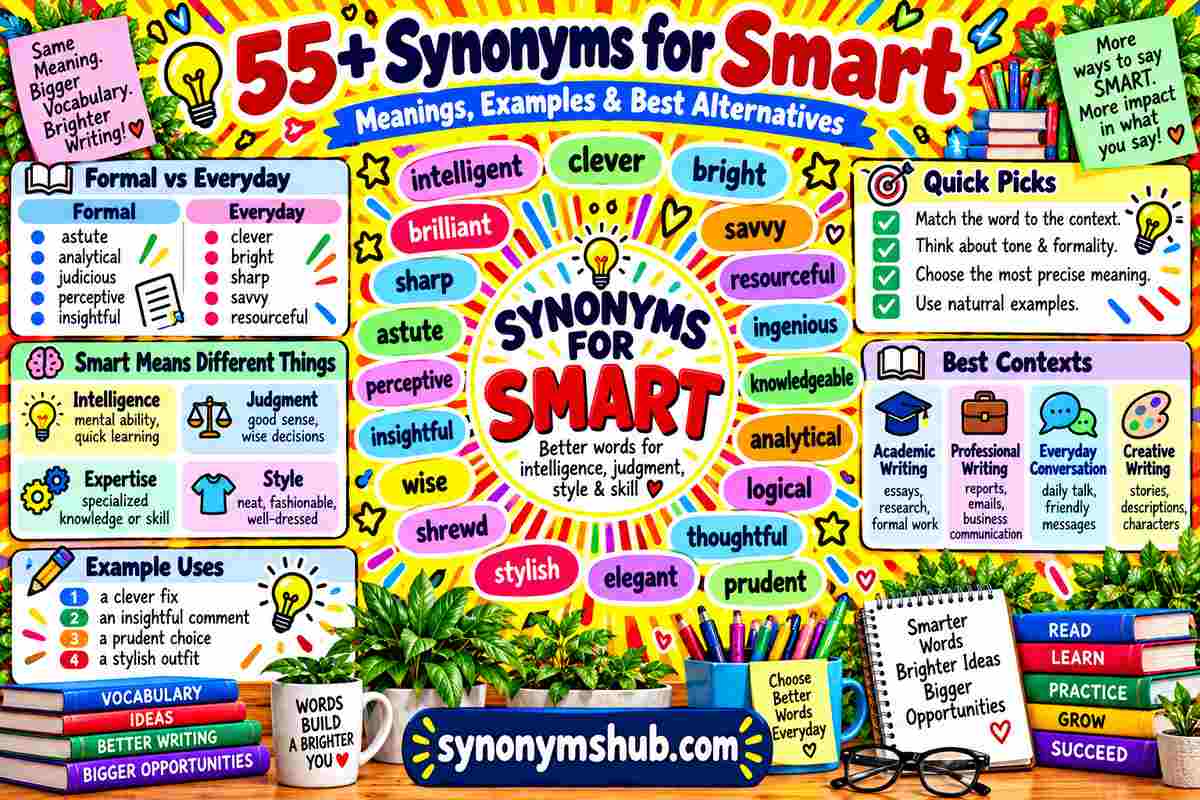
To describe someone as smart is to acknowledge their intelligence, quickness of thought, or good judgment. A student who can solve complex math problems, a coworker making thoughtful decisions and a friend who is always finding practical solutions can be described as such.
But the word doesn’t convey exactly what is meant by that intelligent person. There can be people who know more but can’t be as inventive as others, or there can be people who have great senses but don’t know much.
With a bit of practice, you can make these distinctions with the help of Exploring Synonyms for Smart. For example, clever means quick in thinking, while wise means good in judgment, and perceptive means discerning.
This guide shows you 56 useful alternatives, their meanings, original examples, tones, and writing tips. You’ll also discover how to select the most precise word in academic writing, business communication, creative descriptions, and in your personal interactions.
Quick Answer: Best Synonyms for Smart
Looking for a better word but haven’t read through this guide? These are the 12 most common alternatives you can use at the beginning. They have some common elements of intelligence, but each focuses on a different skill, characteristic or circumstance. These Synonyms for Smart don’t replace each other in all sentences. So, select the word used to identify the specific strength you wish to describe.
| Synonym | Simple Meaning | Best Context |
| Intelligent | Able to understand and learn well | Academic and everyday writing |
| Clever | Quick at finding solutions | Conversations and problem-solving |
| Brilliant | Exceptionally intelligent or impressive | Exceptional abilities and ideas |
| Bright | Quick to understand and learn | Students and young learners |
| Sharp | Mentally alert and quick-thinking | Professional and everyday contexts |
| Astute | Quick to recognize important details | Business and decisions |
| Perceptive | Good at noticing subtle things | People and social situations |
| Insightful | Showing deep understanding | Analysis, feedback, and essays |
| Wise | Having sound judgment | Advice and life experience |
| Shrewd | Skilled at judging practical situations | Business and negotiations |
| Knowledgeable | Having substantial information | Expertise and professional writing |
| Ingenious | Exceptionally inventive | Creative solutions and inventions |
What Do Synonyms for Smart Actually Mean?
Smart is usually used to refer to a person who is quick to learn or understand information or is able to make informed decisions. But it has other definitions too.
For instance, a smart student can be intelligent, and a smart investment can be prudent or financially sound. Similarly, a smart outfit is a stylish, neat, or elegant outfit, especially in British English. As such, the Synonyms for Smart do not all refer to the same concept, but rather to several intermingled concepts.
There are 56 alternatives listed below in order of meaning. The first sections consider the brain and logic, whereas other sections differentiate between good judgment and specialized knowledge, practical ability, and style. Some of the entries are synonymous; others only fit in certain contexts.
When to Use Synonyms for Smart in Different Writing Contexts
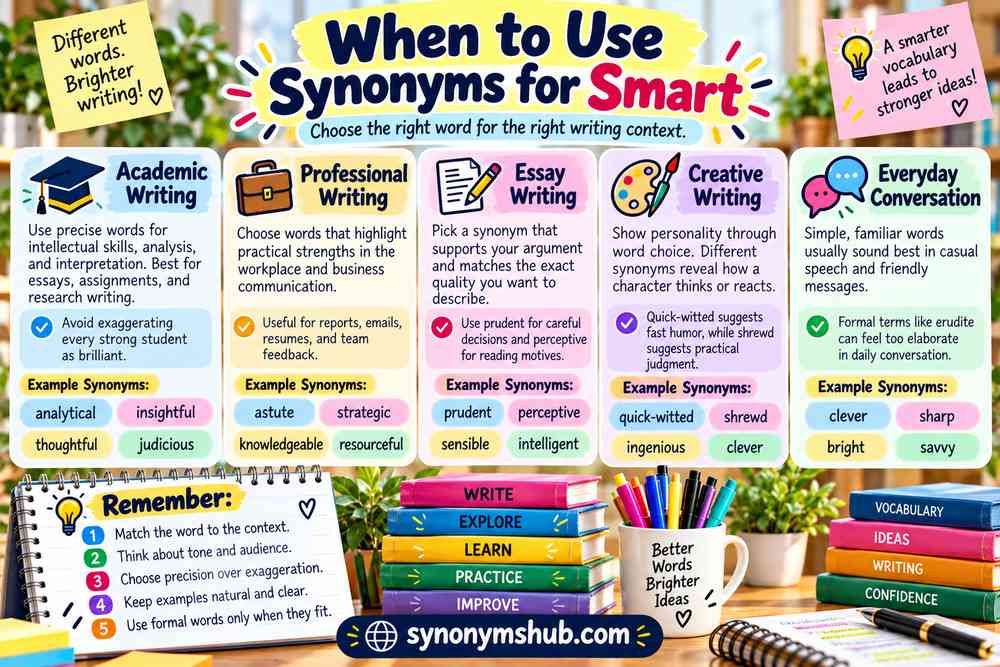
Choosing another word for smart can help you be more descriptive, but only when another word conveys the same meaning. The choice should be based on your audience, purpose and sentence structure.
Academic Writing
Academic writing can benefit from the exact explanations of intellectual skills. For instance, analytical is used to describe someone who analyzes something in a logical way and insightful is used to describe someone who gives a meaningful interpretation of it. But giving a label of “brilliant” to every successful student could be an exaggeration of their demonstrated skills.
Professional Writing
In workplace communication, words like astute, strategic, knowledgeable and resourceful describe specific strengths. For example, a smart manager is able to see the key business news, whereas a clever employee is able to invent ways of getting to work with little time and materials.
Essay Writing
For essay writers, it is important that they select alternatives that enhance the argument. When talking about making wise choices, say that the leader was prudent, and when talking about understanding people’s motivations, say that the leader was perceptive, rather than just “smart.
Creative Writing
Creative descriptions become richer when intelligence is demonstrated through personality. A quick-witted character produces immediate humorous replies, while a shrewd merchant recognizes a risky bargain. Therefore, the adjective can help reveal how a character thinks.
Everyday Conversation
Common phrases tend to sound the most natural when they are spoken in an informal context. It would be a good idea to say a person is clever if they solved a problem or sharp if they spotted a mistake. Yeah, words like erudite sound unnecessarily wordy in a friendly text.
Read More: 55+ Synonyms for Great With Alternative Meanings & Real-Life Examples
Common Synonyms for Smart in Everyday English
Some words are general terms that refer to intelligence; others refer to outstanding ability or mental alertness. These are particularly helpful in talking about students, friends, colleagues, and those who grasp new ideas quickly.
1. Intelligent
| Meaning | Able to understand, learn, and reason effectively. |
| Tone | Neutral, respectful, and widely applicable. |
| Example | “Nora is an intelligent student who enjoys exploring difficult scientific questions.” |
| Explanation | A direct alternative when referring to general mental ability. |
| Purpose | Education, professional profiles, and everyday descriptions. |
| Best Alternatives | Bright, clever, brilliant. |
2. Clever
| Meaning | Quick at understanding situations or finding effective solutions. |
| Tone | Friendly, positive, and conversational. |
| Example | “That clever solution saved us from buying an entirely new washing machine.” |
| Explanation | Often emphasizes mental quickness or ingenuity rather than extensive knowledge. |
| Purpose | Problem-solving, conversation, and creative thinking. |
| Best Alternatives | Sharp, ingenious, quick-witted. |
3. Bright
| Meaning | Quick to learn, understand, or recognize ideas. |
| Tone | Warm, encouraging, and informal. |
| Example | “The bright young pianist learned the complicated melody surprisingly quickly.” |
| Explanation | Commonly used when praising students and promising learners. |
| Purpose | Education, parenting, and personal descriptions. |
| Best Alternatives | Intelligent, gifted, brainy. |
4. Brilliant
| Meaning | Exceptionally intelligent, impressive, or outstanding. |
| Tone | Strong, admiring, and enthusiastic. |
| Example | “Her brilliant explanation made the mathematical proof understandable to everyone.” |
| Explanation | Stronger praise than smart and best reserved for exceptional performance. |
| Purpose | Academic achievements, innovative ideas, and exceptional ability. |
| Best Alternatives | Ingenious, intelligent, gifted. |
5. Sharp
| Meaning | Mentally alert and quick to notice or understand things. |
| Tone | Confident, natural, and conversational. |
| Example | “Even during a long meeting, the editor remained sharp enough to catch inconsistencies.” |
| Explanation | Often describes alertness and fast recognition. |
| Purpose | Workplace observations, thinking skills, and conversation. |
| Best Alternatives | Keen, astute, bright. |
6. Quick-Witted
| Meaning | Able to respond immediately with clever or humorous remarks. |
| Tone | Lively, positive, and expressive. |
| Example | “The quick-witted host handled the unexpected interruption with a hilarious response.” |
| Explanation | Emphasizes verbal intelligence rather than overall academic ability. |
| Purpose | Humor, dialogue, entertainment, and personality descriptions. |
| Best Alternatives | Witty, clever, sharp. |
7. Brainy
| Meaning | Very intelligent, especially in intellectual or academic subjects. |
| Tone | Informal and usually complimentary. |
| Example | “Our brainy cousin enjoys solving complex chess puzzles during family gatherings.” |
| Explanation | Casual language that can sometimes sound playful. |
| Purpose | Everyday conversation, student descriptions, and informal writing. |
| Best Alternatives | Bright, intelligent, intellectual. |
8. Intellectual
| Meaning | Interested in or concerned with serious thinking and complex ideas. |
| Tone | Formal, thoughtful, and academic. |
| Example | “Her intellectual curiosity led to discussions about history, philosophy, and political theory.” |
| Explanation | Describes an orientation toward ideas, not necessarily superior intelligence. |
| Purpose | Academic discussions, biographies, and cultural writing. |
| Best Alternatives | Scholarly, analytical, learned. |
9. Gifted
| Meaning | Having exceptional natural ability in a particular area. |
| Tone | Appreciative and respectful. |
| Example | “The gifted teenager could compose intricate melodies without formal training.” |
| Explanation | May describe intellectual, artistic, or other abilities. |
| Purpose | Education, arts, and discussions of exceptional talent. |
| Best Alternatives | Talented, brilliant, able. |
10. Talented
| Meaning | Possessing notable ability or aptitude. |
| Tone | Positive and widely understood. |
| Example | “A talented young engineer designed the prototype during her internship.” |
| Explanation | Broader than intelligence because talent also includes artistic and practical skills. |
| Purpose | Performance, education, careers, and creative work. |
| Best Alternatives | Gifted, skilled, accomplished. |
11. Able
| Meaning | Having the ability or competence to perform something effectively. |
| Tone | Neutral and practical. |
| Example | “An able administrator can manage competing priorities without losing important details.” |
| Explanation | Praises competence rather than intelligence alone. |
| Purpose | Professional assessments and practical responsibilities. |
| Best Alternatives | Capable, competent, proficient. |
12. Capable
| Meaning | Having the qualities or abilities needed to accomplish a task. |
| Tone | Respectful, professional, and reassuring. |
| Example | “The capable technician diagnosed the equipment failure before production resumed.” |
| Explanation | A contextual alternative for someone whose smart approach produces dependable results. |
| Purpose | Workplace performance and everyday competence. |
| Best Alternatives | Able, proficient, skilled. |
Synonyms for Smart When Describing Reasoning and Perception
Intelligence is not just a memory problem. Some people pick up on the nuances, analyze some of the facts carefully, or ask some very interesting questions. Such context-specific alternatives illustrate the way in which a person thinks about a piece of information rather than their overall intelligence.
13. Astute
| Meaning | Quick to understand situations and recognize important opportunities. |
| Tone | Professional, admiring, and precise. |
| Example | “The astute investor noticed warning signs before the company’s financial difficulties became public.” |
| Explanation | Particularly appropriate for practical judgment in complex situations. |
| Purpose | Business, finance, leadership, and analytical writing. |
| Best Alternatives | Shrewd, perceptive, sharp. |
14. Perceptive
| Meaning | Skilled at noticing subtle details and understanding underlying meanings. |
| Tone | Thoughtful and complimentary. |
| Example | “A perceptive teacher noticed that the quiet student was struggling with the assignment.” |
| Explanation | Emphasizes sensitivity to information that others may overlook. |
| Purpose | Education, relationships, and character descriptions. |
| Best Alternatives | Discerning, observant, insightful. |
15. Insightful
| Meaning | Showing a deep and accurate understanding of something. |
| Tone | Professional, appreciative, and thoughtful. |
| Example | “Her insightful review explained why customers were abandoning the checkout process.” |
| Explanation | Commonly describes observations, comments, and analysis. |
| Purpose | Research, feedback, literary criticism, and professional writing. |
| Best Alternatives | Perceptive, analytical, discerning. |
16. Discerning
| Meaning | Able to recognize important differences and make careful judgments. |
| Tone | Refined and somewhat formal. |
| Example | “Discerning buyers examined the warranty details before choosing a refrigerator.” |
| Explanation | Highlights careful evaluation and refined judgment. |
| Purpose | Reviews, purchasing decisions, and critical assessments. |
| Best Alternatives | Perceptive, judicious, selective. |
17. Analytical
| Meaning | Skilled at examining information systematically to understand its components. |
| Tone | Academic, technical, and professional. |
| Example | “Her analytical approach revealed a pattern in the monthly sales figures.” |
| Explanation | Describes a thinking method, not intelligence in every sense. |
| Purpose | Research, data analysis, business, and science. |
| Best Alternatives | Logical, systematic, rational. |
18. Logical
| Meaning | Following clear reasoning and consistent principles. |
| Tone | Objective and precise. |
| Example | “The engineer proposed a logical explanation for the recurring software errors.” |
| Explanation | Emphasizes reasoning rather than creativity or accumulated knowledge. |
| Purpose | Mathematics, arguments, problem-solving, and technical writing. |
| Best Alternatives | Rational, analytical, reasonable. |
19. Rational
| Meaning | Guided by reason rather than unsupported assumptions or impulses. |
| Tone | Formal, balanced, and objective. |
| Example | “They made a rational decision after comparing the risks of both proposals.” |
| Explanation | Particularly useful for decisions and arguments based on evidence. |
| Purpose | Essays, decision-making, and professional analysis. |
| Best Alternatives | Logical, sensible, reasonable. |
20. Thoughtful
| Meaning | Showing careful consideration or serious reflection. |
| Tone | Warm, respectful, and flexible. |
| Example | “The committee appreciated his thoughtful response to the complicated ethical question.” |
| Explanation | Can also mean considerate, so the intended sense depends on context. |
| Purpose | Essays, feedback, decisions, and personal descriptions. |
| Best Alternatives | Reflective, considered, insightful. |
21. Reflective
| Meaning | Inclined to think carefully about experiences and ideas. |
| Tone | Calm, thoughtful, and academic. |
| Example | “The reflective student reconsidered her assumptions after hearing another perspective.” |
| Explanation | Suggests deliberate thinking rather than instant mental speed. |
| Purpose | Personal essays, education, and character development. |
| Best Alternatives | Thoughtful, contemplative, analytical. |
22. Observant
| Meaning | Good at noticing details or changes in the surroundings. |
| Tone | Neutral and complimentary. |
| Example | “The observant mechanic spotted a small crack that previous inspections had missed.” |
| Explanation | An appropriate replacement when smartness involves close attention. |
| Purpose | Investigations, workplaces, and creative descriptions. |
| Best Alternatives | Perceptive, attentive, sharp. |
23. Inquisitive
| Meaning | Eager to ask questions and discover new information. |
| Tone | Positive, intellectual, and descriptive. |
| Example | “The inquisitive child wanted to know why some insects glow at night.” |
| Explanation | Indicates a desire to learn, not necessarily existing knowledge. |
| Purpose | Education, personality, and learning behavior. |
| Best Alternatives | Curious, questioning, investigative. |
24. Curious
| Meaning | Interested in discovering or understanding unfamiliar things. |
| Tone | Friendly, natural, and versatile. |
| Example | “Curious about the old telescope, Marcus began studying astronomy.” |
| Explanation | Related to intellectual engagement rather than a direct measure of intelligence. |
| Purpose | Childhood learning, science, and personal interests. |
| Best Alternatives | Inquisitive, interested, exploratory. |
Synonyms for Smart When Describing Wisdom & Good Judgment
Comprehending complex topics while having difficulties with routine choices. On the other hand, it’s possible for a person with fine practical judgment to handle challenges well without a lot of schooling. Yeah, these Synonyms for Smart focus on sensible choice, experience, adaptability and strategic thinking.
25. Wise
| Meaning | Having good judgment developed through knowledge or experience. |
| Tone | Respectful and meaningful. |
| Example | “Her wise advice encouraged the graduates to consider long-term consequences.” |
| Explanation | Emphasizes judgment rather than quick learning. |
| Purpose | Advice, leadership, relationships, and life decisions. |
| Best Alternatives | Prudent, sensible, judicious. |
26. Sensible
| Meaning | Showing practical judgment and reasonable decision-making. |
| Tone | Natural and approving. |
| Example | “Taking a break before driving home was a sensible choice.” |
| Explanation | Appropriate for reasonable, realistic decisions. |
| Purpose | Everyday planning, safety, and personal advice. |
| Best Alternatives | Wise, rational, prudent. |
27. Prudent
| Meaning | Careful to avoid unnecessary risks or problems. |
| Tone | Formal and professional. |
| Example | “Building an emergency fund was a prudent financial decision.” |
| Explanation | Emphasizes caution and planning rather than sheer intelligence. |
| Purpose | Finance, policy, risk management, and formal essays. |
| Best Alternatives | Judicious, sensible, cautious. |
28. Judicious
| Meaning | Demonstrating careful, balanced, and sound judgment. |
| Tone | Formal and precise. |
| Example | “The editor made judicious changes without altering the author’s intended message.” |
| Explanation | Suitable when describing restraint and appropriate decisions. |
| Purpose | Academic writing, professional reviews, and leadership. |
| Best Alternatives | Wise, prudent, discerning. |
29. Shrewd
| Meaning | Skilled at understanding practical situations and personal interests. |
| Tone | Strong, businesslike, and sometimes calculating. |
| Example | “The shrewd negotiator secured favorable terms without damaging the partnership.” |
| Explanation | Often suggests commercially useful intelligence or strategic awareness. |
| Purpose | Business, negotiations, finance, and fiction. |
| Best Alternatives | Astute, savvy, sharp. |
30. Savvy
| Meaning | Having a practical understanding of how something works. |
| Tone | Contemporary, informal, and confident. |
| Example | “Savvy online shoppers compare return policies before placing expensive orders.” |
| Explanation | Often used with areas such as technology, business, or media. |
| Purpose | Consumer advice, marketing, and everyday communication. |
| Best Alternatives | Shrewd, knowledgeable, streetwise. |
31. Streetwise
| Meaning | Experienced in handling practical difficulties and unfamiliar social situations. |
| Tone | Informal and realistic. |
| Example | “The streetwise traveler recognized the suspicious offer and walked away.” |
| Explanation | Refers to practical awareness gained through experience. |
| Purpose | Travel, urban settings, characters, and everyday situations. |
| Best Alternatives | Savvy, resourceful, experienced. |
32. Resourceful
| Meaning | Able to find practical solutions despite limited resources. |
| Tone | Positive and appreciative. |
| Example | “The resourceful volunteers built temporary shelves from donated materials.” |
| Explanation | Praises problem-solving under difficult circumstances. |
| Purpose | Work, emergencies, teamwork, and personal development. |
| Best Alternatives | Ingenious, adaptable, capable. |
33. Ingenious
| Meaning | Exceptionally clever and inventive in solving problems. |
| Tone | Strong, admiring, and descriptive. |
| Example | “The inventor developed an ingenious device that collected rainwater automatically.” |
| Explanation | Best for unusually clever ideas, methods, or inventions. |
| Purpose | Engineering, innovation, technology, and creative solutions. |
| Best Alternatives | Inventive, clever, brilliant. |
34. Inventive
| Meaning | Skilled at producing imaginative or original ideas. |
| Tone | Positive and creative. |
| Example | “The inventive teacher transformed a cardboard box into an interactive science model.” |
| Explanation | Focuses on originality and practical imagination. |
| Purpose | Education, engineering, art, and design. |
| Best Alternatives | Ingenious, creative, innovative. |
35. Innovative
| Meaning | Introducing new ideas, methods, or approaches. |
| Tone | Professional and forward-looking. |
| Example | “The innovative startup developed a more accessible way to manage prescriptions.” |
| Explanation | Describes originality applied to improvements, not intelligence generally. |
| Purpose | Business, research, technology, and product development. |
| Best Alternatives | Inventive, pioneering, creative. |
36. Strategic
| Meaning | Planned to achieve a particular long-term objective. |
| Tone | Professional and purposeful. |
| Example | “Her strategic decision to expand gradually protected the business from excessive debt.” |
| Explanation | A contextual alternative for smart planning and decision-making. |
| Purpose | Business strategy, management, and long-term planning. |
| Best Alternatives | Calculated, deliberate, tactical. |
Synonyms for Smart When Describing Knowledge & Expertise
Being smart sometimes means possessing detailed knowledge or having developed a high level of skill. However, education, expertise, and intelligence aren’t identical qualities. These alternatives are most accurate when you can identify someone’s particular knowledge, training, or demonstrated competence.
37. Knowledgeable
| Meaning | Possessing substantial knowledge about a subject. |
| Tone | Professional, positive, and neutral. |
| Example | “The knowledgeable museum guide explained the history behind each ancient artifact.” |
| Explanation | Describes what someone knows rather than their general intelligence. |
| Purpose | Expertise, education, and professional communication. |
| Best Alternatives | Well-informed, learned, educated. |
38. Learned
| Meaning | Having extensive knowledge acquired through study. |
| Tone | Formal and scholarly. |
| Example | “The learned historian provided valuable context for the newly discovered manuscript.” |
| Explanation | As an adjective describing a person, it is pronounced LUR-nid. |
| Purpose | Academic writing, history, and intellectual discussions. |
| Best Alternatives | Erudite, scholarly, knowledgeable. |
39. Erudite
| Meaning | Possessing or demonstrating extensive scholarly knowledge. |
| Tone | Highly formal and intellectual. |
| Example | “Her erudite lecture connected ancient philosophy with modern ethical debates.” |
| Explanation | More specialized than intelligent and rarely needed in casual conversation. |
| Purpose | Academic criticism, literature, and scholarly descriptions. |
| Best Alternatives | Learned, scholarly, well-read. |
40. Scholarly
| Meaning | Characterized by serious academic study and research. |
| Tone | Formal and academic. |
| Example | “The scholarly article examined competing interpretations of the historical evidence.” |
| Explanation | Describes academic habits or work rather than intelligence alone. |
| Purpose | Universities, research, and academic publications. |
| Best Alternatives | Academic, learned, intellectual. |
41. Well-Informed
| Meaning | Having accurate and relevant information about a subject. |
| Tone | Neutral and professional. |
| Example | “Well-informed voters compared the candidates’ policy proposals before deciding.” |
| Explanation | Highlights current understanding rather than intellectual talent. |
| Purpose | Journalism, public discussion, research, and decisions. |
| Best Alternatives | Knowledgeable, informed, educated. |
42. Educated
| Meaning | Having received education or developed knowledge through learning. |
| Tone | Neutral and context-dependent. |
| Example | “An educated audience may still appreciate explanations of unfamiliar technical terms.” |
| Explanation | Educational background should not be confused with inherent intelligence. |
| Purpose | Education, social research, and professional writing. |
| Best Alternatives | Learned, knowledgeable, well-informed. |
43. Literate
| Meaning | Able to read and write or competent within a particular knowledge area. |
| Tone | Neutral and educational. |
| Example | “Financially literate teenagers are better prepared to understand credit agreements.” |
| Explanation | A contextual alternative when smart means understanding a specific system. |
| Purpose | Education, technology, finance, and communication. |
| Best Alternatives | Knowledgeable, informed, proficient. |
44. Articulate
| Meaning | Able to express ideas clearly and effectively. |
| Tone | Professional and complimentary. |
| Example | “The articulate researcher explained the complex findings without unnecessary jargon.” |
| Explanation | Describes communication ability, not general intelligence. |
| Purpose | Interviews, presentations, leadership, and writing. |
| Best Alternatives | Eloquent, expressive, clear-spoken. |
45. Proficient
| Meaning | Competent and skilled at a particular activity. |
| Tone | Formal and professional. |
| Example | “The accountant is proficient in preparing complex financial statements.” |
| Explanation | Usually identifies a specific learned capability. |
| Purpose | Résumés, professional evaluations, and technical abilities. |
| Best Alternatives | Skilled, adept, competent. |
46. Adept
| Meaning | Highly skilled or effective at doing something. |
| Tone | Professional and approving. |
| Example | “The mediator was adept at calming disagreements between project partners.” |
| Explanation | Commonly followed by at or in when describing a skill. |
| Purpose | Workplace performance, interpersonal abilities, and expertise. |
| Best Alternatives | Proficient, skilled, accomplished. |
47. Skilled
| Meaning | Having developed strong ability through experience or training. |
| Tone | Neutral and professional. |
| Example | “A skilled carpenter restored the damaged staircase without replacing its original design.” |
| Explanation | Focuses on demonstrated practical ability. |
| Purpose | Trades, careers, technology, and professional descriptions. |
| Best Alternatives | Adept, proficient, capable. |
48. Accomplished
| Meaning | Highly skilled or successful through substantial achievement. |
| Tone | Respectful, formal, and appreciative. |
| Example | “The accomplished surgeon also mentors young doctors entering the profession.” |
| Explanation | Emphasizes developed expertise or achievement rather than mental speed. |
| Purpose | Professional biographies, careers, and artistic performance. |
| Best Alternatives | Skilled, proficient, distinguished. |
Read More: 55+ Synonyms for Help With Alternative Meanings & Real-Life Examples
Synonyms for Smart When Describing Style and Appearance
Not every use of smart concerns intelligence. In British English especially, a smart outfit or smart appearance often means neat, stylish, or attractively dressed. These eight alternatives relate to clothing and presentation. Therefore, they shouldn’t be substituted for smart when describing intellectual ability.
49. Stylish
| Meaning | Fashionable and attractive in design. |
| Tone | Positive and widely understood. |
| Example | “Her stylish navy blazer looked appropriate for the conference.” |
| Explanation | A direct alternative to smart when referring to an attractive appearance. |
| Purpose | Fashion, clothing, interiors, and personal descriptions. |
| Best Alternatives | Chic, fashionable, elegant. |
50. Fashionable
| Meaning | Following or reflecting current styles and trends. |
| Tone | Neutral and descriptive. |
| Example | “The fashionable jacket featured a relaxed cut and understated detailing.” |
| Explanation | Emphasizes trends more than neatness or formality. |
| Purpose | Fashion writing, shopping, and personal style. |
| Best Alternatives | Stylish, trendy, chic. |
51. Chic
| Meaning | Stylish in an elegant, attractive, and sophisticated way. |
| Tone | Refined and complimentary. |
| Example | “The café’s chic interior combined natural wood with simple lighting.” |
| Explanation | Often describes fashion, design, and tasteful appearance. |
| Purpose | Fashion articles, interiors, and lifestyle descriptions. |
| Best Alternatives | Stylish, elegant, sophisticated. |
52. Elegant
| Meaning | Graceful, tasteful, and attractively simple or refined. |
| Tone | Formal and admiring. |
| Example | “The guests admired her elegant evening dress at the reception.” |
| Explanation | Can also describe beautifully simple solutions, but not intelligence generally. |
| Purpose | Formal clothing, architecture, design, and refined writing. |
| Best Alternatives | Chic, graceful, sophisticated. |
53. Polished
| Meaning | Refined, carefully prepared, or professionally presented. |
| Tone | Professional and approving. |
| Example | “His polished appearance helped him make a confident first impression.” |
| Explanation | Often emphasizes presentation, refinement, and attention to detail. |
| Purpose | Professional appearance, speeches, and workplace communication. |
| Best Alternatives | Refined, sophisticated, well-groomed. |
54. Dapper
| Meaning | Neat, stylish, and attractively dressed, especially of a man. |
| Tone | Warm, descriptive, and slightly old-fashioned. |
| Example | “The dapper gentleman arrived wearing a tailored suit and polished shoes.” |
| Explanation | A specific style-related alternative, not an intelligence synonym. |
| Purpose | Fashion descriptions, portraits, and creative writing. |
| Best Alternatives | Stylish, neat, well-dressed. |
55. Snappy
| Meaning | Stylish, lively, or attractively fashionable in appearance. |
| Tone | Informal and expressive. |
| Example | “He wore a snappy patterned tie that brightened his otherwise plain suit.” |
| Explanation | Can also mean quick or irritable, depending on context. |
| Purpose | Fashion, casual reviews, and expressive descriptions. |
| Best Alternatives | Stylish, sharp-looking, fashionable. |
56. Sophisticated
| Meaning | Refined, cultured, or highly developed. |
| Tone | Formal, positive, and versatile. |
| Example | “The restaurant’s sophisticated décor featured muted colors and contemporary artwork.” |
| Explanation | May describe refined style or complex technology, depending on context. |
| Purpose | Design, professional writing, technology, and lifestyle. |
| Best Alternatives | Elegant, refined, polished. |
Synonyms for Smart: Meaning, Intensity & Formality Comparison
Different alternatives emphasize different qualities. Therefore, ranking all of them on a single intelligence scale would be misleading. For instance, brilliant communicates stronger admiration than intelligent. Meanwhile, prudent and resourceful don’t necessarily indicate greater intelligence; they describe different kinds of effective thinking.
The table below shows how selected Synonyms for Smart differ in meaning, degree of praise, and usual formality.
| Word | Main Meaning | Typical Emphasis | Formality |
| Smart | Intelligent or sensible | General ability or judgment | Neutral |
| Intelligent | Good at understanding | Overall intellectual ability | Neutral |
| Clever | Quick at solving problems | Mental quickness | Neutral |
| Bright | Quick to learn | Learning potential | Informal to neutral |
| Brilliant | Exceptionally intelligent | Strong admiration | Neutral |
| Sharp | Mentally alert | Quick recognition | Informal to neutral |
| Astute | Recognizes important opportunities | Practical judgment | Professional |
| Perceptive | Notices subtle details | Awareness and understanding | Neutral to formal |
| Insightful | Shows deep understanding | Quality of interpretation | Professional |
| Wise | Exercises good judgment | Experience and decisions | Neutral |
| Shrewd | Recognizes practical advantage | Business judgment | Neutral to formal |
| Prudent | Avoids unnecessary risks | Caution and foresight | Formal |
| Resourceful | Finds workable solutions | Practical adaptability | Neutral |
| Ingenious | Exceptionally inventive | Original solutions | Neutral to formal |
| Knowledgeable | Possesses relevant information | Subject expertise | Neutral |
| Erudite | Extensively scholarly | Learned knowledge | Highly formal |
| Stylish | Fashionable or attractive | Appearance, not intelligence | Neutral |
Before-and-After Sentences Using Better Alternatives for Smart
Replacing smart with a more precise adjective can clarify the reason you’re praising someone. However, the improved sentence should remain natural.
Example 1: Academic Writing
Basic: The smart student understood the scientific theory.
Improved: The analytical student examined the evidence supporting the scientific theory.
Why it works: Analytical identifies a specific method of thinking rather than making a general claim about intelligence.
Example 2: Professional Communication
Basic: Our manager made a smart business decision.
Improved: Our manager made a prudent decision to reduce unnecessary spending.
Why it works: Prudent highlights careful financial judgment and risk awareness.
Example 3: Everyday Conversation
Basic: That was a smart way to fix the shelf.
Improved: That was a clever way to repair the shelf without buying new parts.
Why it works: Clever draws attention to the practical solution.
Example 4: Creative Writing
Basic: The smart detective noticed something strange.
Improved: The perceptive detective noticed that the witness avoided one particular question.
Why it works: Perceptive helps readers understand the character’s attention to subtle behavior.
Example 5: Professional Achievement
Basic: She is a smart software developer.
Improved: She is a resourceful software developer who finds solutions under tight deadlines.
Why it works: Resourceful describes her ability to overcome practical limitations.
Example 6: Fashion Description
Basic: He wore a smart outfit to the ceremony.
Improved: He wore an elegant charcoal suit to the ceremony.
Why it works: Elegant clearly describes a formal appearance instead of intellectual ability.
Common Mistakes to Avoid When Using Synonyms for Smart
One common vocabulary mistake is assuming that every positive adjective can replace smart. However, knowledge, creativity, good judgment, and practical skill are different qualities. Before choosing from the available Synonyms for Smart, check what the sentence actually describes. Remember that a precise adjective doesn’t always need to praise intelligence.
| Common Mistake | Incorrect or Weak Example | Better Correction |
| Confusing intelligence with style | “She is a fashionable mathematician” when praising ability. | “She is a brilliant mathematician.” |
| Exaggerating ordinary ability | “He’s a brilliant employee because he arrived on time.” | “He’s a reliable employee.” |
| Confusing knowledge with judgment | “The knowledgeable investment was successful.” | “The prudent investment was successful.” |
| Using an unnatural combination | “She made a brainy financial decision.” | “She made a sensible financial decision.” |
| Choosing unnecessary formal language | “My erudite little brother fixed my bicycle.” | “My clever little brother fixed my bicycle.” |
| Repeating one adjective excessively | “The smart student made a smart choice using a smart method.” | “The bright student chose an effective method.” |
| Confusing curiosity with intelligence | “He’s intelligent because he asks many questions.” | “He’s inquisitive and enjoys learning.” |
How to Choose the Right Synonym for Smart
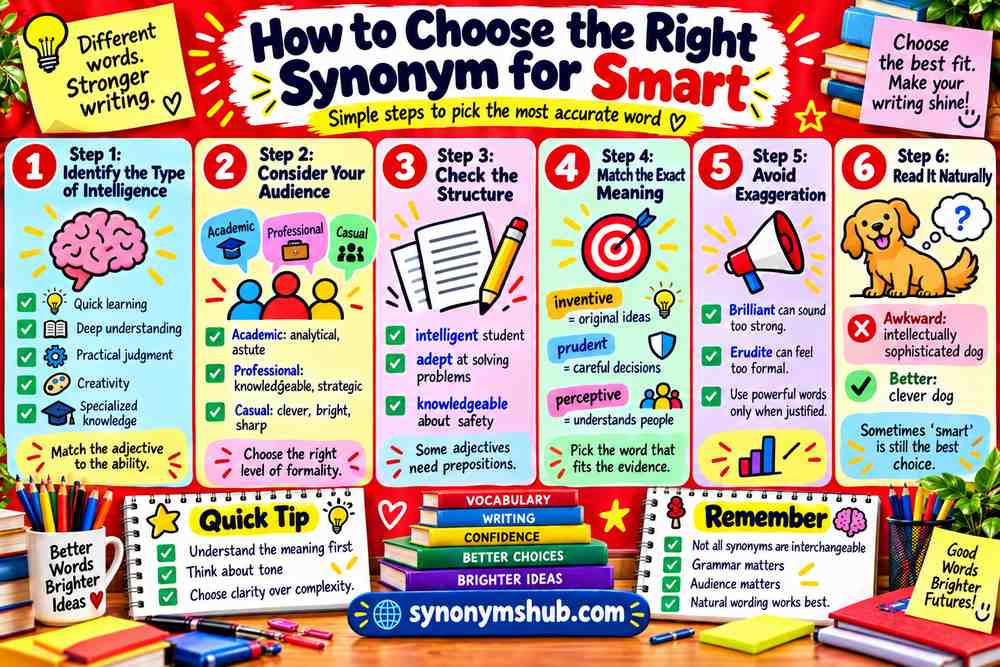
Selecting a good alternative becomes easier when you understand the particular quality being described. Although several words overlap, differences in emphasis, formality, and grammar can affect how your sentence sounds.
Step 1: Identify the Type of Intelligence
First, decide whether you’re describing quick learning, deep understanding, practical judgment, creativity, or specialized knowledge.
For example, bright works well for a student who learns quickly, while wise describes someone who consistently gives sound advice. Matching the adjective to the ability makes your description more meaningful.
Step 2: Consider Your Audience and Writing Style
Next, think about who will read your sentence.
Academic and professional writing often benefits from precise words such as analytical, astute, and knowledgeable.
However, familiar alternatives like clever, sharp, and bright usually sound more natural in everyday conversations.
Choose the level of formality that suits your audience.
Step 3: Check the Grammatical Structure
Adjectives can appear before nouns or after linking verbs, but particular combinations may sound more natural than others.
For example:
- Intelligent:“She’s an intelligent student.”
- Adept:“He’s adept at solving technical problems.”
- Knowledgeable:“The consultant is knowledgeable about workplace safety.”
Notice that adept commonly takes at or in, while knowledgeable often appears with about or in.
Step 4: Match the Word to Its Exact Meaning
Although inventive, prudent, and perceptive can all describe smart people, they identify different abilities.
An inventor might be ingenious because of an original design. Meanwhile, a financial adviser could be prudent because of careful risk management.
Therefore, choose words that accurately reflect the evidence.
Step 5: Avoid Exaggeration and Unnecessary Complexity
Stronger words aren’t automatically better.
For instance, describing someone as brilliant merely because they remembered an appointment may sound exaggerated. Likewise, erudite can feel unnatural in a casual message.
Instead, reserve powerful or formal vocabulary for situations that justify it.
Step 6: Read the Finished Sentence Naturally
Finally, read your sentence aloud. If a replacement sounds awkward, overly dramatic, or unclear, revise it.
For example, “My intellectually sophisticated dog learned to sit” sounds unnatural. “My clever dog learned a new trick” is more appropriate. Sometimes, the familiar word smart is still the best choice.
Conclusion
Exploring Synonyms for Smart reveals how many different qualities one familiar adjective can describe. Intelligent, clever, and bright express general mental ability, while astute, wise, and prudent emphasize judgment. Meanwhile, ingenious highlights creativity, and knowledgeable focuses on expertise.
The most effective alternative isn’t necessarily the most impressive-sounding word. Instead, choose vocabulary that reflects the actual situation, matches your audience, and sounds natural. Understanding these differences will help you write clearer essays, give more meaningful compliments, and communicate confidently in professional and everyday settings.
Frequently Asked Questions
What are some common synonyms for smart?
Common alternatives include intelligent, clever, bright, brilliant, sharp, wise, and astute. Each describes a slightly different aspect of mental ability or judgment.
What are five strong synonyms for smart?
Five useful choices are brilliant, ingenious, astute, perceptive, and insightful. However, their strengths lie in different areas, including invention, judgment, observation, and understanding.
What is a formal synonym for smart?
Intelligent is suitable for general formal writing. Meanwhile, astute, analytical, judicious, and erudite are useful when describing more specific intellectual qualities.
What are easy synonyms for smart for kids?
Clever, bright, intelligent, sharp, and brainy are familiar alternatives. However, explain how each word differs so children understand when to use it.
What is the difference between smart and clever?
Smart broadly describes intelligence or good judgment. Clever more specifically emphasizes quick thinking, ingenuity, or the ability to find effective solutions.
Is brilliant a stronger word than smart?
Generally, yes. Brilliant expresses exceptional intelligence or admiration, while smart offers more ordinary praise. Therefore, use brilliant when the achievement genuinely deserves stronger emphasis.
Can smart mean stylish instead of intelligent?
Yes. Particularly in British English, smart can describe neat, fashionable clothing or appearance. In that context, stylish, elegant, and chic are appropriate alternatives.