
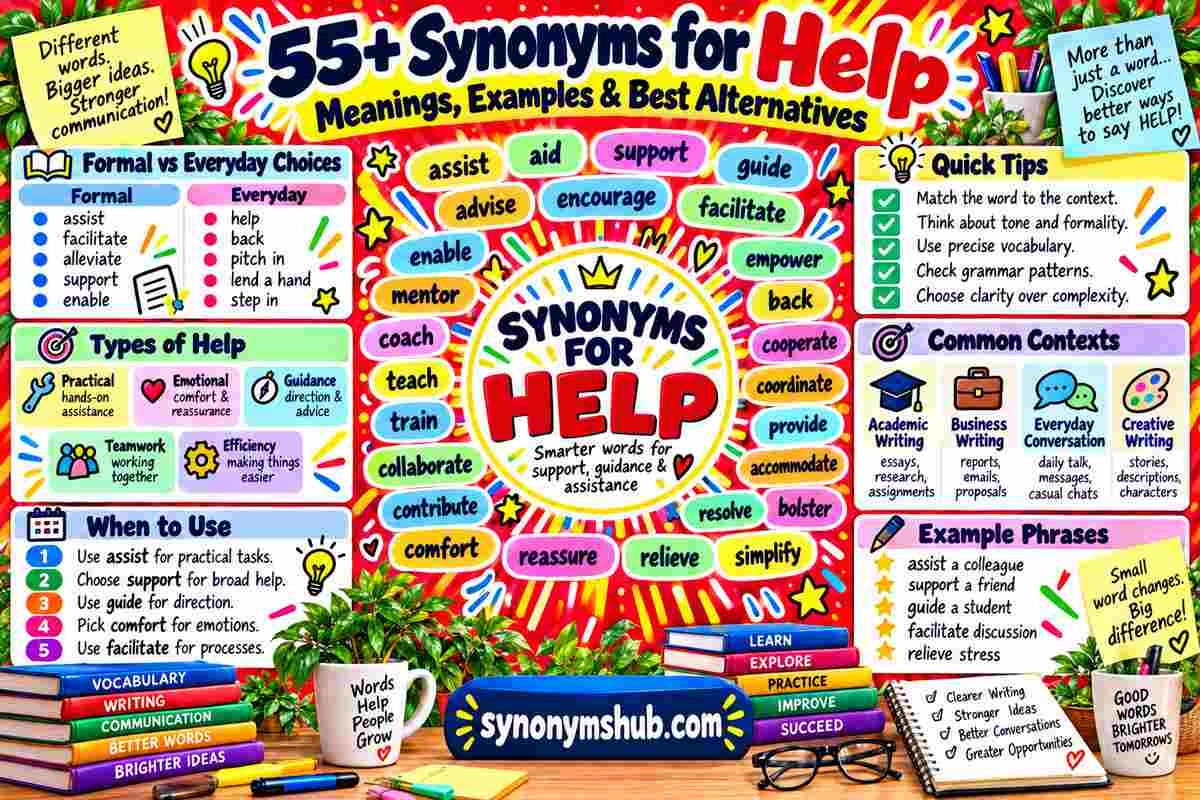
You use the term “help” many times per day, even if you don’t realize it. You may ask a classmate to help you complete your assignments, express appreciation to a coworker who assisted in completing a task, or explain that a new piece of software allows employees to perform tasks more efficiently. While the word “help” is effective and can be used in numerous ways, overusing this word can create predictable writing.
Choosing the best synonyms for help gives you a way to describe precisely the type of help that a person is providing. Some examples are: “assist,” which means active participation in doing something; “guide,” which implies giving direction; and “support,” which may refer to both emotional and physical encouragement.
There are several other words that can be used interchangeably, but they may differ depending on whether you’re writing a formal paper or having a casual conversation. This guide will provide 56 alternative words along with their simple definitions, actual examples, different tones, and recommendations on how to select the best word for your situation.
What Are the Best Synonyms for Help (Quick Answer)
Are you looking for an appropriate synonym to use in your writing, but don’t want to read through the entire guide? Use the following twelve most commonly used synonyms for help as a starting point. Your selection of which one to use should depend on what type of help you need: practical assistance, emotional support, advice, cooperative effort, etc. All of the other Synonyms for Help listed below have specialized usage based upon context.
| Synonym | Simple Meaning | Best Context |
| Assist | Give practical help | Professional and everyday tasks |
| Aid | Provide necessary assistance | Formal writing and emergencies |
| Support | Offer practical or emotional backing | Work, relationships, and education |
| Back | Support someone’s decision or effort | Informal and professional communication |
| Guide | Show someone the right direction | Learning and decision-making |
| Advise | Suggest what someone should do | Professional and personal decisions |
| Encourage | Give someone confidence | Motivation and emotional support |
| Cooperate | Work together toward a goal | Teamwork and shared responsibilities |
| Contribute | Add something useful to an effort | Projects, discussions, and communities |
| Relieve | Reduce someone’s burden | Workloads, discomfort, and responsibilities |
| Facilitate | Make a process easier | Academic and business writing |
| Enable | Make something possible | Technology, education, and opportunities |
What Do Synonyms for Help Actually Mean?
Help is a common English word that has many different meanings. It indicates making things possible for other people, such as providing support to others, helping with problems, taking on part of the responsibility of others, and comforting people who are sad. For example, a teacher might help a student understand a complex concept, or a friend could comfort another person who is feeling down.
Similarly, a person may be able to assist another colleague with a task, while computer programming may be able to make a difficult process easier. However, both types of behavior relate to assisting others; neither conveys precisely the same concept. As such, knowing what the goal of an action is will make it possible to choose the best option.
When to Use Synonyms for Help in Different Writing Contexts

Vocab selection is much more than selecting a word that has the same definition. In various contexts, there are varying degrees of precision, formality and emotion expressed.
Academic Writing
Academic writing is enhanced when the author uses terminology that specifies particular types of interaction processes. For example, “help people learn” is equivalent to “facilitate learning”; “show support for my idea” is equivalent to “support a hypothesis.” However, it would be inappropriate to substitute “help” with a more formal term in every instance, as this will lead to an unnecessarily complicated explanation of the study.
Professional Writing
Business communication is characterized by the use of terms like assist, coordinate, streamline, and facilitate. They help identify what was done and what the outcome of that action was. For example, saying “I assisted in completing the quarterly report” would be acceptable when discussing your accomplishments during a performance review. However, if you were to say “I streamlined the reporting process,” this indicates you made an operational improvement.
Essay Writing
When writing essays, it’s better to use language that aligns with what you want to say. For instance, rather than stating “Education helps society,” you can state “Education promotes social development.” However, always use the most appropriate alternative word choice if it provides an accurate reflection of what you’re trying to convey. It is much more important to be clear and precise in your language use than to make it sound impressive.
Creative Writing
Creative writing allows more expressive descriptions of assistance and relationships. A character might rally around a grieving neighbor or comfort a frightened child. Both of these examples illustrate the emotional connection between two individuals, which would not be evident using the single word “help.” Therefore, creative writing creates a more detailed picture for readers.
Everyday Conversation
In everyday conversation, the most straightforward options are often the best choices. For example, if you would like your friend to help you with your groceries, you may use the phrase “lend a hand.” Or, when inviting coworkers to assist you at an event, you can use the phrase “pitch in.” Also, some phrases like “I’m here to support you” can be friendlier than using formal language.
Read More: 55+ Synonyms for Happy With Meanings & Real-Life Examples
Common Synonyms for Help in Everyday English
The terms represent the different ways people can assist each other, the ways people can participate directly with each other, and the way one person stands with another in need. Most are used commonly in everyday speech, but many have more precise definitions or degrees of formality.
1. Assist
Meaning: To give someone practical help in completing a task.
Tone: Neutral to formal.
Example: “The librarian assisted students with finding reliable research materials.”
Best Used For: Workplace duties, education, customer service, and practical tasks.
Best Alternatives: Aid, support, lend a hand.
2. Aid
Meaning: To assist, especially when someone faces difficulty.
Tone: Formal and purposeful.
Example: “Local volunteers aided families affected by the severe flooding.”
Best Used For: Humanitarian work, emergencies, healthcare, and formal writing.
Best Alternatives: Assist, support, relieve.
3. Support
Meaning: To provide assistance, encouragement, or resources.
Tone: Neutral and versatile.
Example: “Her parents supported her decision to pursue a nursing degree.”
Best Used For: Family relationships, professional development, and emotional encouragement.
Best Alternatives: Back, assist, encourage.
4. Back
Meaning: To support someone’s plans, decisions, or efforts.
Tone: Conversational and confident.
Example: “The department manager backed the team’s proposal for flexible working hours.”
Best Used For: Decisions, projects, teamwork, and personal commitments.
Best Alternatives: Support, endorse, stand by.
5. Lend a Hand
Meaning: To offer practical assistance with an activity.
Tone: Friendly and informal.
Example: “Could you lend a hand carrying these boxes upstairs?”
Best Used For: Household chores, everyday requests, and friendly cooperation.
Best Alternatives: Assist, pitch in, step in.
6. Pitch In
Meaning: To join an activity and contribute effort.
Tone: Informal and cooperative.
Example: “Everyone pitched in to prepare the community center for Saturday’s event.”
Best Used For: Group activities, shared responsibilities, and volunteer work.
Best Alternatives: Contribute, participate, lend a hand.
7. Come to Someone’s Aid
Meaning: To provide assistance when someone needs it.
Tone: Descriptive and slightly formal.
Example: “Nearby residents came to the cyclist’s aid after the accident.”
Best Used For: Emergencies, unexpected problems, and supportive actions.
Best Alternatives: Assist, aid, step in.
8. Stand By
Meaning: To remain supportive during difficult circumstances.
Tone: Reassuring and personal.
Example: “Her closest friends stood by her throughout the difficult transition.”
Best Used For: Loyalty, emotional support, and personal relationships.
Best Alternatives: Support, back, reassure.
9. Rally Around
Meaning: To come together and support someone facing a challenge.
Tone: Warm and encouraging.
Example: “The neighborhood rallied around the family after their house fire.”
Best Used For: Community support, difficult experiences, and group encouragement.
Best Alternatives: Support, come to someone’s aid, stand by.
10. Be of Service
Meaning: To provide useful assistance to another person.
Tone: Polite and professional.
Example: “Please tell me how I can be of service during your visit.”
Best Used For: Hospitality, customer service, and formal offers of assistance.
Best Alternatives: Assist, aid, support.
11. Step In
Meaning: To become involved when assistance or intervention is necessary.
Tone: Neutral and practical.
Example: “The supervisor stepped in when the team struggled with conflicting instructions.”
Best Used For: Leadership, urgent situations, and resolving workplace difficulties.
Best Alternatives: Intervene, assist, come to someone’s aid.
12. Volunteer
Meaning: To offer time or services willingly, without being required.
Tone: Positive and purposeful.
Example: “Several students volunteered to organize the school charity fundraiser.”
Best Used For: Community events, charitable activities, and optional responsibilities.
Best Alternatives: Offer assistance, contribute, pitch in.
Synonyms for Help When Giving Guidance or Advice
Sometimes, when we are trying to help someone, it can be more effective to share our knowledge with them than to do the work for them. These terms describe how you can teach, explain, mentor, or guide others so that they make better choices and have a deeper understanding of the world.
13. Guide
Meaning: To provide direction or advice that helps someone progress.
Tone: Supportive and neutral.
Example: “The counselor guided students through their college application choices.”
Best Used For: Education, planning, career decisions, and personal development.
Best Alternatives: Direct, advise, mentor.
14. Advise
Meaning: To offer recommendations based on knowledge or experience.
Tone: Professional and thoughtful.
Example: “The accountant advised the business owner to review monthly expenses.”
Best Used For: Professional recommendations, financial decisions, and planning.
Best Alternatives: Counsel, guide, recommend.
15. Counsel
Meaning: To provide thoughtful guidance about important personal or professional matters.
Tone: Formal and supportive.
Example: “The career adviser counseled graduates about their employment options.”
Best Used For: Career guidance, legal matters, and personal decisions.
Best Alternatives: Advise, guide, mentor.
16. Mentor
Meaning: To guide someone’s development through experience and ongoing advice.
Tone: Professional and encouraging.
Example: “An experienced engineer mentored the new employees during their first year.”
Best Used For: Career growth, leadership development, and education.
Best Alternatives: Coach, guide, advise.
17. Coach
Meaning: To train or guide someone toward improved performance.
Tone: Motivational and practical.
Example: “The presentation coach helped executives improve their public speaking skills.”
Best Used For: Sports, performance, communication, and professional development.
Best Alternatives: Train, mentor, instruct.
18. Tutor
Meaning: To teach someone individually or in a small group.
Tone: Educational and specific.
Example: “A university student tutored her younger brother in mathematics.”
Best Used For: School subjects, exam preparation, and private education.
Best Alternatives: Teach, instruct, coach.
19. Instruct
Meaning: To teach or explain how something should be done.
Tone: Clear and authoritative.
Example: “The technician instructed staff on operating the new equipment safely.”
Best Used For: Procedures, technical training, and workplace instructions.
Best Alternatives: Teach, train, guide.
20. Teach
Meaning: To help someone acquire knowledge, understanding, or skills.
Tone: Neutral and educational.
Example: “Her grandfather taught her how to repair an old bicycle.”
Best Used For: Learning, practical skills, and personal development.
Best Alternatives: Tutor, instruct, train.
21. Train
Meaning: To develop someone’s abilities through instruction and practice.
Tone: Professional and practical.
Example: “The company trained employees to recognize common cybersecurity threats.”
Best Used For: Workplace skills, sports, and technical education.
Best Alternatives: Coach, instruct, teach.
22. Orient
Meaning: To familiarize someone with a new environment or situation.
Tone: Professional and educational.
Example: “The university organized a workshop to orient international students.”
Best Used For: Employee onboarding, education, and unfamiliar environments.
Best Alternatives: Familiarize, introduce, guide.
Synonyms for Help Through Teamwork and Cooperation
Helping is not always about a single individual providing assistance to another individual to resolve their issues. On the contrary, individuals often help each other through the sharing of knowledge by contributing resources or by collaborating toward achieving similar objectives. All of these concepts indicate collaborative effort and cooperation among people.
23. Cooperate
Meaning: To work together willingly toward a shared purpose.
Tone: Neutral and professional.
Example: “The two departments cooperated to improve customer response times.”
Best Used For: Teamwork, organizational tasks, and joint responsibilities.
Best Alternatives: Collaborate, coordinate, work alongside.
24. Collaborate
Meaning: To work jointly with others to produce something.
Tone: Professional and constructive.
Example: “Researchers from three universities collaborated on the environmental study.”
Best Used For: Academic projects, creative work, and business partnerships.
Best Alternatives: Cooperate, partner with, team up.
25. Contribute
Meaning: To provide something useful toward a shared effort.
Tone: Neutral and purposeful.
Example: “Every committee member contributed ideas during the planning meeting.”
Best Used For: Group discussions, donations, research, and projects.
Best Alternatives: Participate, pitch in, provide.
26. Participate
Meaning: To take part in an activity or shared effort.
Tone: Neutral and inclusive.
Example: “Several parents participated in the school’s weekend cleanup campaign.”
Best Used For: Community programs, events, and group activities.
Best Alternatives: Join in, contribute, cooperate.
27. Join Forces
Meaning: To combine efforts with others toward a shared goal.
Tone: Energetic and cooperative.
Example: “Two local charities joined forces to distribute winter clothing.”
Best Used For: Partnerships, campaigns, and collaborative projects.
Best Alternatives: Collaborate, team up, cooperate.
28. Team Up
Meaning: To work with another person or group on something.
Tone: Friendly and informal.
Example: “Maya teamed up with her cousin to organize the birthday celebration.”
Best Used For: Everyday projects, teamwork, and shared plans.
Best Alternatives: Join forces, collaborate, partner with.
29. Chip In
Meaning: To contribute money or resources toward a shared purpose.
Tone: Informal and cooperative.
Example: “Everyone chipped in ten dollars to buy a farewell gift.”
Best Used For: Shared expenses, fundraising, and group contributions.
Best Alternatives: Contribute, donate, pitch in.
30. Partner With
Meaning: To work with someone in a cooperative relationship.
Tone: Professional and neutral.
Example: “The nonprofit partnered with local businesses to provide school supplies.”
Best Used For: Business partnerships, community programs, and joint initiatives.
Best Alternatives: Collaborate, cooperate, join forces.
31. Share the Load
Meaning: To divide responsibilities so one person carries less pressure.
Tone: Supportive and conversational.
Example: “The siblings shared the load of caring for their elderly father.”
Best Used For: Family responsibilities, demanding projects, and teamwork.
Best Alternatives: Assist, pitch in, relieve.
32. Work Alongside
Meaning: To work with someone on a task or responsibility.
Tone: Neutral and professional.
Example: “The experienced designer worked alongside interns during the website redesign.”
Best Used For: Mentoring, workplace collaboration, and shared projects.
Best Alternatives: Collaborate, cooperate, partner with.
33. Coordinate
Meaning: To organize activities or efforts so people work effectively together.
Tone: Professional and organized.
Example: “The event manager coordinated volunteers during the charity marathon.”
Best Used For: Project management, events, and group operations.
Best Alternatives: Organize, facilitate, collaborate.
Synonyms for Help When Reducing Difficulties or Offering Comfort
Assistance can also mean making someone’s life less difficult. These context-specific alternatives describe reducing burdens, comforting people, offering reassurance, and protecting someone from potential problems.
34. Relieve
Meaning: To reduce a burden, discomfort, or responsibility.
Tone: Neutral and practical.
Example: “The additional assistant relieved the receptionist of several administrative duties.”
Best Used For: Workload reduction, discomfort, and stressful situations.
Best Alternatives: Ease, alleviate, lighten.
35. Alleviate
Meaning: To make pain, problems, or difficulties less severe.
Tone: Formal and precise.
Example: “The community program aims to alleviate food insecurity among local families.”
Best Used For: Healthcare, social issues, academic writing, and policy.
Best Alternatives: Relieve, ease, reduce.
36. Ease
Meaning: To make a difficulty, process, or feeling less intense.
Tone: Natural and versatile.
Example: “A clear timetable eased students’ concerns about the examination schedule.”
Best Used For: Anxiety, complicated tasks, discomfort, and transitions.
Best Alternatives: Alleviate, relieve, simplify.
37. Lighten
Meaning: To make a burden, mood, or workload less heavy.
Tone: Conversational and descriptive.
Example: “Sharing the household chores lightened her responsibilities considerably.”
Best Used For: Workloads, emotional pressure, and everyday tasks.
Best Alternatives: Ease, relieve, reduce.
38. Comfort
Meaning: To provide emotional reassurance or relief during distress.
Tone: Warm and compassionate.
Example: “Her sister comforted her after the disappointing interview.”
Best Used For: Sadness, emotional difficulties, and personal relationships.
Best Alternatives: Console, reassure, support.
39. Console
Meaning: To comfort someone experiencing sadness or disappointment.
Tone: Compassionate and thoughtful.
Example: “His teammates consoled him after the championship defeat.”
Best Used For: Grief, disappointment, and emotional setbacks.
Best Alternatives: Comfort, reassure, support.
40. Reassure
Meaning: To reduce someone’s worries by providing confidence or reassurance.
Tone: Supportive and calming.
Example: “The nurse reassured the patient before the medical examination.”
Best Used For: Anxiety, uncertainty, and sensitive conversations.
Best Alternatives: Comfort, encourage, support.
41. Encourage
Meaning: To give someone confidence or motivation to continue.
Tone: Positive and supportive.
Example: “The teacher encouraged quiet students to participate in classroom discussions.”
Best Used For: Motivation, learning, personal goals, and emotional support.
Best Alternatives: Inspire, motivate, reassure.
42. Care For
Meaning: To look after someone’s health, safety, or well-being.
Tone: Caring and personal.
Example: “The home health aide cared for residents recovering from surgery.”
Best Used For: Healthcare, family responsibilities, and personal care.
Best Alternatives: Tend to, support, look after.
43. Tend To
Meaning: To attend to someone’s needs or take care of something.
Tone: Neutral and slightly formal.
Example: “The gardener tended to damaged plants after the storm.”
Best Used For: Caregiving, gardening, maintenance, and practical responsibilities.
Best Alternatives: Care for, attend to, maintain.
44. Protect
Meaning: To keep someone or something safe from harm.
Tone: Strong and purposeful.
Example: “The new safety procedures protect workers from hazardous equipment.”
Best Used For: Safety, prevention, healthcare, and security.
Best Alternatives: Safeguard, defend, shield.
Read More: 55+ Synonyms for Great With Alternative Meanings & Real-Life Examples
Synonyms for Help When Making Tasks Easier
In academic and professional writing, the term “help” usually refers to something that either enhances efficiency, eliminates barriers, or allows a subsequent action to take place. Therefore, it may be better to use the more precise alternative terms above to accurately convey the intended outcome.
45. Facilitate
Meaning: To make an activity or process easier to complete.
Tone: Formal and professional.
Example: “The online platform facilitates communication between teachers and parents.”
Best Used For: Business processes, academic research, and organizational communication.
Best Alternatives: Enable, simplify, streamline.
46. Enable
Meaning: To make something possible by providing necessary resources or conditions.
Tone: Neutral to formal.
Example: “The scholarship enabled several students to continue their university education.”
Best Used For: Education, technology, opportunities, and accessibility.
Best Alternatives: Empower, facilitate, equip.
47. Empower
Meaning: To give someone greater ability, authority, or confidence to act.
Tone: Positive and professional.
Example: “The training program empowered employees to make independent decisions.”
Best Used For: Leadership, education, personal development, and communities.
Best Alternatives: Enable, equip, encourage.
48. Equip
Meaning: To provide the tools, knowledge, or skills needed for something.
Tone: Practical and professional.
Example: “The workshop equipped participants with essential interviewing skills.”
Best Used For: Training, preparation, education, and professional development.
Best Alternatives: Prepare, provide, enable.
49. Provide
Meaning: To supply something that someone needs.
Tone: Neutral and professional.
Example: “The organization provided laptops to students attending online classes.”
Best Used For: Resources, services, education, and practical assistance.
Best Alternatives: Supply, contribute, furnish.
50. Accommodate
Meaning: To adjust arrangements to meet someone’s particular needs.
Tone: Professional and considerate.
Example: “The conference organizers accommodated participants who required wheelchair access.”
Best Used For: Accessibility, workplace adjustments, hospitality, and scheduling.
Best Alternatives: Assist, adapt, make arrangements for.
51. Expedite
Meaning: To make a process happen more quickly.
Tone: Formal and business-oriented.
Example: “The manager expedited the approval process for urgent repair requests.”
Best Used For: Administrative procedures, deliveries, and time-sensitive tasks.
Best Alternatives: Accelerate, speed up, facilitate.
52. Simplify
Meaning: To make something easier to understand or complete.
Tone: Neutral and practical.
Example: “The instructor simplified the complicated formula using a familiar example.”
Best Used For: Teaching, explanations, instructions, and processes.
Best Alternatives: Clarify, ease, streamline.
53. Streamline
Meaning: To improve efficiency by removing unnecessary steps.
Tone: Professional and technical.
Example: “The company streamlined its ordering process to reduce customer waiting times.”
Best Used For: Business operations, technology, and workflow improvement.
Best Alternatives: Simplify, optimize, facilitate.
54. Troubleshoot
Meaning: To identify and address the causes of a problem.
Tone: Technical and practical.
Example: “The IT specialist troubleshot the network connection before the presentation.”
Best Used For: Technology, equipment, systems, and technical support.
Best Alternatives: Diagnose, investigate, resolve.
55. Resolve
Meaning: To find a solution to a problem or disagreement.
Tone: Professional and decisive.
Example: “The customer service representative resolved the billing error within an hour.”
Best Used For: Customer complaints, conflicts, and technical problems.
Best Alternatives: Settle, solve, rectify.
56. Bolster
Meaning: To strengthen or reinforce something through additional support.
Tone: Formal and confident.
Example: “The additional research findings bolstered the team’s original argument.”
Best Used For: Academic writing, arguments, confidence, and organizational support.
Best Alternatives: Strengthen, reinforce, support.
Synonyms for Help: Meaning, Intensity & Formality Comparison
Not all helping actions can be compared using one intensity scale. Emotional comfort, practical assistance, and process improvement describe different kinds of support. Therefore, the table below provides an explanation for the meanings of these expressions as well as their general emphasis and levels of formality.
| Word | Main Meaning | Typical Emphasis | Formality |
| Help | General assistance | Broad, neutral | Neutral |
| Assist | Practical assistance | Direct involvement | Neutral to formal |
| Aid | Necessary assistance | Support during difficulty | Often formal |
| Support | Provide backing | Practical or emotional | Neutral |
| Guide | Give direction | Advice and learning | Neutral |
| Encourage | Build confidence | Motivation | Neutral |
| Comfort | Ease emotional distress | Emotional care | Neutral |
| Alleviate | Reduce difficulty | Severity reduction | Formal |
| Facilitate | Make a process easier | Efficiency and progress | Formal |
| Enable | Make an action possible | Opportunity or capability | Neutral to formal |
| Empower | Increase ability or authority | Independence | Often formal |
| Streamline | Remove unnecessary steps | Efficiency | Professional |
| Bolster | Strengthen existing support | Reinforcement | Formal |
Before-and-After Sentences Using Better Alternatives for Help
Replacing a general verb with a more precise alternative can improve clarity. However, the replacement should preserve what actually happened.
Example 1: Professional Communication
Basic: The assistant helped the manager organize the conference.
Improved: The assistant coordinated conference arrangements with the manager.
Why it works: Coordinated highlights organizing activities and responsibilities.
Example 2: Academic Writing
Basic: The new teaching method helped students understand difficult concepts.
Improved: The new teaching method facilitated students’ understanding of difficult concepts.
Why it works: Facilitated emphasizes making the learning process easier.
Example 3: Everyday Conversation
Basic: My brother helped me move the furniture.
Improved: My brother lent a hand moving the furniture.
Why it works: The expression sounds friendly and natural.
Example 4: Emotional Support
Basic: Her friends helped her after the disappointing news.
Improved: Her friends comforted her after the disappointing news.
Why it works: Comforted identifies the emotional nature of their assistance.
Example 5: Technology
Basic: The software helped employees complete routine tasks faster.
Improved: The software streamlined routine tasks for employees.
Why it works: Streamlined emphasizes improved efficiency and fewer unnecessary steps.
Example 6: Personal Development
Basic: The training helped participants become more confident.
Improved: The training empowered participants to make decisions confidently.
Why it works: Empowered emphasizes developing the capability and confidence to act independently.
Common Mistakes to Avoid When Using Synonyms for Help
One of the most frequent errors in using vocabulary is thinking that you may use any related term without changing the sentence. While there are some overlapping options, most of those alternatives require a change in grammar or refer to a different action.
The best Synonyms for Help should communicate the actual action rather than make your sentence longer. Therefore, you will want to verify the definition, grammar, and natural collocation of each synonym you choose before using a term that may be foreign to your vocabulary.
| Common Mistake | Incorrect or Weak Example | Better Correction |
| Treating every alternative as interchangeable | “She facilitated her sad friend.” | “She comforted her sad friend.” |
| Using formal language unnecessarily | “Please facilitate my grocery bags.” | “Please help me carry these groceries.” |
| Confusing enabling with assisting | “The grant assisted the course to exist.” | “The grant enabled the course to operate.” |
| Incorrect verb patterns | “He explained me the procedure.” | “He explained the procedure to me.” |
| Choosing a word with the wrong emphasis | “The doctor streamlined her pain.” | “The doctor helped alleviate her pain.” |
| Repeating one formal alternative | “The program facilitated learning and facilitated communication.” | “The program supported learning and improved communication.” |
| Exaggerating someone’s contribution | “I resolved the project by attending one meeting.” | “I contributed ideas during one project meeting.” |
How to Choose the Right Synonym for Help
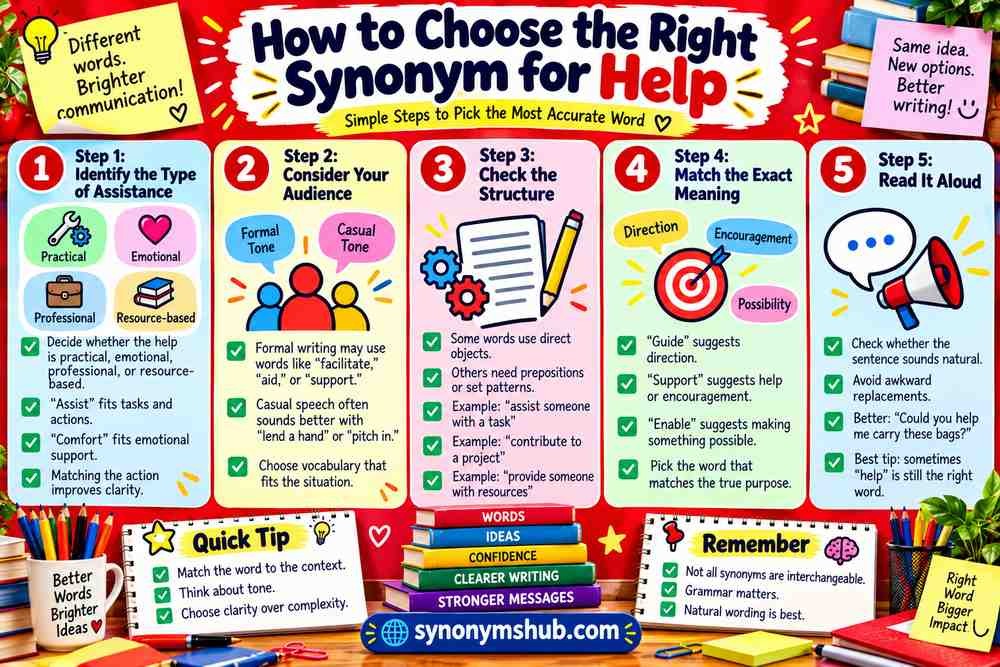
You will find it simpler to choose the correct alternative after learning about the type of support that is referred to. However, Many words have similar meanings; their tone, grammatical form, and application may vary. To find natural and correct alternatives for “help,” follow the following simple rules.
Step 1: Identify the Type of Assistance
First, determine what kind of help your sentence describes. Someone might offer practical assistance, emotional support, professional advice, or useful resources.
For example, assist works well for completing tasks, while comfort describes helping someone feel better emotionally. Therefore, choosing a word that matches the action makes your meaning clearer.
Step 2: Consider Your Audience and Writing Style
Next, think about who will read or hear your message. Professional and academic writing often benefits from precise words such as facilitate, aid, or support.
However, everyday conversations usually sound more natural with expressions like lend a hand or pitch in. Choose vocabulary that fits the situation rather than using complicated words unnecessarily.
Step 3: Check the Grammatical Structure
Different synonyms require different sentence structures. Some verbs take direct objects, while others need specific prepositions.
For example:
- Assist: “She assisted her colleague with the presentation.”
- Contribute: “He contributed to the community project.”
- Provide: “The organization provided students with learning materials.”
Using the correct grammatical pattern helps your writing sound accurate and natural.
Step 4: Match the Word to Its Exact Meaning
Although guide, support, and enable are related to helping, they describe different actions. Guide emphasizes direction, support provides assistance or encouragement, and enable makes something possible.
For instance, a teacher may guide students through an assignment, while a scholarship may enable them to continue their education. Therefore, consider the intended meaning before replacing the original word.
Step 5: Read the Sentence and Check Its Natural Flow
Finally, read your completed sentence aloud to ensure the replacement sounds natural and preserves your intended meaning.
For example, “Could you facilitate me with these bags?” sounds awkward. Instead, “Could you help me carry these bags?” is clearer and more conversational.
So, remember that the best synonym isn’t always the most formal or impressive word. Sometimes, help remains the most accurate and natural choice.
Conclusion
Exploring Synonyms for Help reveals how one familiar word can describe many different actions. Assist and aid express practical involvement, while guide, mentor, and advise focus on sharing knowledge. Meanwhile, comfort and reassure emphasize emotional support, whereas facilitate, enable, and streamline describe making processes easier or possible.
The most effective alternative isn’t necessarily the longest or most formal word. Instead, choose vocabulary that accurately reflects the situation, fits your audience, and sounds natural within the sentence. With practice, these distinctions can make everyday conversations, essays, and professional communication clearer and more expressive.
Frequently Asked Questions
What are some common synonyms for help?
Common alternatives include assist, aid, support, guide, and encourage. Each describes a particular kind of assistance, so the best choice depends on context.
What are five easy synonyms for help?
Five useful alternatives are assist, aid, support, guide, and back. These words describe practical assistance, encouragement, direction, or support for someone’s efforts.
What is a stronger word for help?
Bolster, empower, and rescue can express more specific actions. However, they aren’t universally stronger replacements because their meanings depend on the situation.
What is a formal synonym for help?
Assist and aid are common formal alternatives. Meanwhile, facilitate works when describing processes, while alleviate refers to reducing difficulties.
What is another word for help in an essay?
Depending on your argument, consider support, contribute, facilitate, enable, or encourage. Choose the word that accurately explains the action or relationship.
What are easy synonyms for help for kids?
Children can learn assist, support, guide, share, and lend a hand. Simple examples involving homework, chores, and playground activities make these meanings easier to understand.
What is the difference between help and assist?
Help is a broad, everyday word, while assist sounds slightly more formal and often emphasizes practical involvement in completing a task.