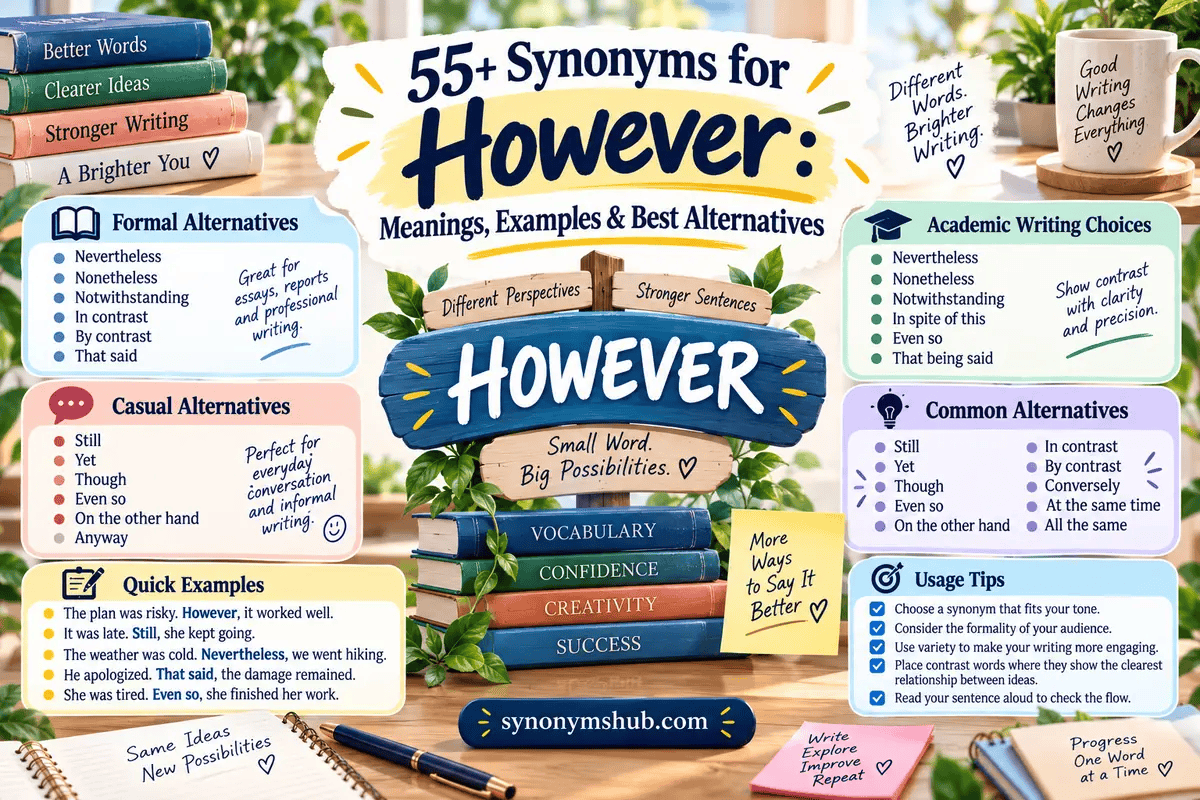
However” is useful, but it has a habit of showing up far too often. You see it in essays, emails, reports, and explanations because it does the job well. Still, when the same word appears again and again, even a strong paragraph can start to feel stiff.
That is where Synonyms for however can help. Sometimes but is enough. In other cases, yet, nevertheless, still, in contrast, or on the other hand may fit better. The important thing is not to swap words just for the sake of variety. Pick the one that matches the tone and the kind of contrast you actually want to express.
What Do Synonyms for However Actually Mean?
“However” usually signals a change in direction. It tells the reader that the next idea does not fully agree with, support, or follow from the first one.
Take this sentence:
“The restaurant was expensive. However, the food was excellent.”
You could also write:
“The restaurant was expensive. Still, the food was excellent.”
Or:
“The restaurant was expensive, but the food was excellent.”
The idea is similar, but the grammar and tone are slightly different. But joins two clauses directly, while however usually stands apart as a transition.
So, Synonyms for however may be used to show:
- Direct contrast
- Unexpected results
- Concessions
- Opposing viewpoints
- Exceptions
- Qualifications
- Alternative perspectives
- A change in direction
- Differences between two ideas
When to Use Synonyms for However
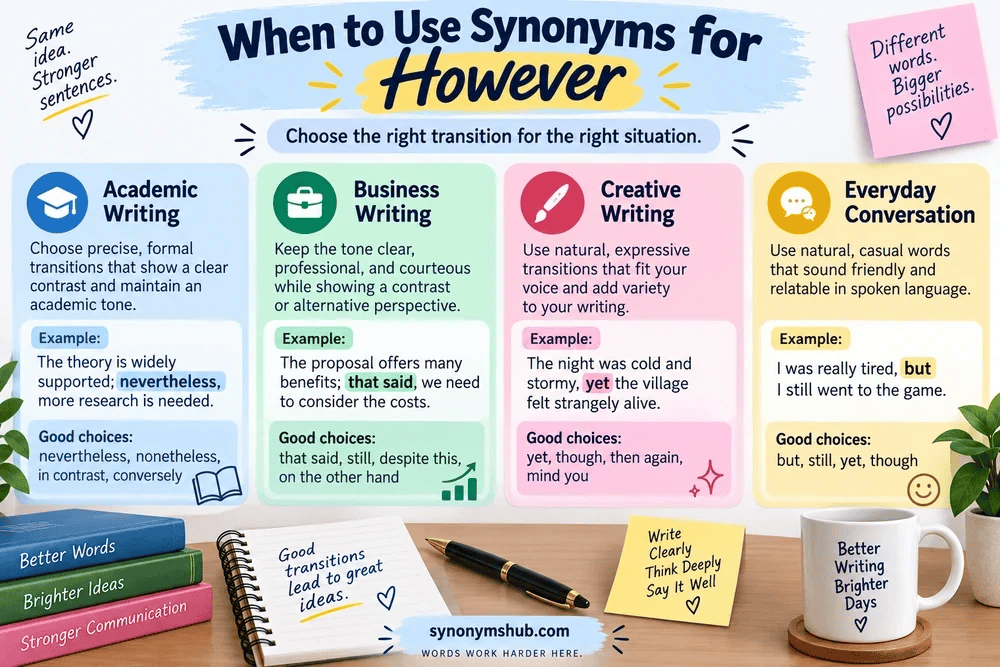
Using a wider range of transitions can make your writing feel smoother, especially when “however” starts appearing too often. That does not mean you should replace it every time, though. Sometimes the original word is still the cleanest choice.
Synonyms for however are especially useful in:
Academic writing often compares claims, results, or viewpoints. In those cases, words such as nevertheless, conversely, in contrast, and nonetheless can make the relationship between ideas more precise.
Reports, proposals, and workplace emails usually sound better when the wording is clear rather than overly formal. Phrases such as that said, still, despite this, or on the other hand often work well.
An essay may compare evidence, introduce a limitation, or present a counterargument. Therefore, alternatives such as yet, even so, by contrast, and admittedly can help vary the flow.
Fiction and personal writing usually benefit from less formal choices. But, though, then again, and mind you can sound more conversational.
People rarely need highly formal transitions in normal speech—simple words such as but, still, yet, and though usually sound the most natural.
55+ Synonyms for However With Meanings, Examples & Best Alternatives
The list below starts with common, everyday choices and gradually moves toward more formal, literary, or less frequently used alternatives.
Keep one thing in mind: these words are not always interchangeable. Some work as conjunctions, others as transitions, and a few only fit certain sentence structures. So, before choosing one, look at the grammar as well as the meaning.
1. But
| Category |
Details |
| Meaning |
Introduces an idea that contrasts with what came before. |
| Tone |
Neutral, common, and conversational. |
| Example |
I wanted to stay longer, but I had an early meeting. |
| Explanation |
The simplest alternative when two contrasting clauses are directly connected. |
| Purpose |
Everyday speech, emails, essays, and informal writing. |
| Best Alternatives |
Yet, Though, Still, However |
2. Yet
| Category |
Details |
| Meaning |
Shows a surprising or unexpected contrast. |
| Tone |
Neutral and slightly polished. |
| Example |
The task looked simple, yet it took several hours. |
| Explanation |
Often emphasizes that the second idea is unexpected. |
| Purpose |
Essays, descriptions, professional writing, and conversation. |
| Best Alternatives |
But, Still, Nevertheless, However |
3. Still
| Category |
Details |
| Meaning |
Introduces a contrasting point despite what was previously stated. |
| Tone |
Natural and flexible. |
| Example |
The journey was exhausting. Still, I would gladly do it again. |
| Explanation |
Useful when the previous fact remains true but does not change the conclusion. |
| Purpose |
Conversation, essays, reviews, and informal professional writing. |
| Best Alternatives |
Even So, Nevertheless, Yet, However |
4. Though
| Category |
Details |
| Meaning |
Introduces contrast or concession. |
| Tone |
Common and conversational. |
| Example |
The room was small. It felt comfortable, though. |
| Explanation |
Especially natural at the end of a sentence in casual English. |
| Purpose |
Conversation, fiction, personal writing, and informal emails. |
| Best Alternatives |
Although, But, However, Yet |
5. Nevertheless
| Category |
Details |
| Meaning |
Means “despite what has just been said.” |
| Tone |
Formal and polished. |
| Example |
The evidence was limited. Nevertheless, the researchers continued the study. |
| Explanation |
Strongly signals that the second statement remains true despite an obstacle. |
| Purpose |
Academic, formal, legal, and analytical writing. |
| Best Alternatives |
Nonetheless, Even So, Still, However |
6. Nonetheless
| Category |
Details |
| Meaning |
Introduces a result or statement that remains valid despite previous information. |
| Tone |
Formal but natural. |
| Example |
The proposal had weaknesses. Nonetheless, the committee approved it. |
| Explanation |
Very close in meaning to “nevertheless.” |
| Purpose |
Academic papers, reports, essays, and formal communication. |
| Best Alternatives |
Nevertheless, Still, Even So, However |
7. Even So
| Category |
Details |
| Meaning |
Means that something remains true despite a previous fact. |
| Tone |
Neutral and readable. |
| Example |
The forecast predicted rain. Even so, we decided to go hiking. |
| Explanation |
Softer and more conversational than “nevertheless.” |
| Purpose |
Essays, speeches, articles, and everyday writing. |
| Best Alternatives |
Still, Nevertheless, Nonetheless, However |
8. That Said
| Category |
Details |
| Meaning |
Introduces a qualification or contrasting viewpoint. |
| Tone |
Professional and conversational. |
| Example |
The software is expensive. That said, it offers excellent support. |
| Explanation |
Acknowledges one point before presenting another side. |
| Purpose |
Reviews, reports, emails, articles, and discussions. |
| Best Alternatives |
Having Said That, Still, However, Even So |
9. That Being Said
| Category |
Details |
| Meaning |
Signals that the next point qualifies the previous one. |
| Tone |
Conversational to semi-formal. |
| Example |
The course is demanding. That being said, it is extremely rewarding. |
| Explanation |
A slightly longer version of “that said.” |
| Purpose |
Commentary, emails, presentations, and general writing. |
| Best Alternatives |
That Said, Having Said That, Nevertheless, Still |
10. Having Said That
| Category |
Details |
| Meaning |
Introduces a contrasting observation after acknowledging an earlier point. |
| Tone |
Polished and moderately formal. |
| Example |
The hotel is far from downtown. Having said that, the area is peaceful. |
| Explanation |
Useful when balancing advantages and disadvantages. |
| Purpose |
Reviews, business writing, essays, and discussion. |
| Best Alternatives |
That Said, However, Even So, On the Other Hand |
11. On the Other Hand
| Category |
Details |
| Meaning |
Presents another side of an issue or comparison. |
| Tone |
Neutral and widely understood. |
| Example |
Working remotely saves travel time. On the other hand, some people miss office interaction. |
| Explanation |
Best when comparing two different viewpoints rather than merely contradicting one statement. |
| Purpose |
Essays, comparisons, discussions, and reports. |
| Best Alternatives |
Conversely, In Contrast, However, By Contrast |
12. In Contrast
| Category |
Details |
| Meaning |
Highlights a noticeable difference between two things. |
| Tone |
Formal and analytical. |
| Example |
City rents increased sharply. In contrast, rural housing costs remained stable. |
| Explanation |
Emphasizes comparison rather than simple disagreement. |
| Purpose |
Academic writing, reports, comparisons, and data analysis. |
| Best Alternatives |
By Contrast, Conversely, However, On the Other Hand |
13. By Contrast
| Category |
Details |
| Meaning |
Introduces information that clearly differs from what came before. |
| Tone |
Formal and concise. |
| Example |
The first experiment produced little change. By contrast, the second produced immediate results. |
| Explanation |
Particularly useful when comparing evidence or results. |
| Purpose |
Academic papers, reports, essays, and analysis. |
| Best Alternatives |
In Contrast, Conversely, However, Whereas |
14. Conversely
| Category |
Details |
| Meaning |
Introduces the reverse or opposite situation. |
| Tone |
Formal and analytical. |
| Example |
High demand can raise prices. Conversely, weak demand may push them down. |
| Explanation |
Works best when the second idea is logically opposite to the first. |
| Purpose |
Research, economics, technical writing, and analytical essays. |
| Best Alternatives |
In Contrast, By Contrast, On the Other Hand, However |
15. At the Same Time
| Category |
Details |
| Meaning |
Acknowledges another, potentially contrasting truth. |
| Tone |
Neutral and natural. |
| Example |
The policy may reduce costs. At the same time, it could create new risks. |
| Explanation |
Shows that two different considerations can both be valid. |
| Purpose |
Essays, reports, discussions, and professional writing. |
| Best Alternatives |
However, Still, That Said, On the Other Hand |
16. Then Again
| Category |
Details |
| Meaning |
Introduces a reconsideration or different perspective. |
| Tone |
Informal and reflective. |
| Example |
We could drive tonight. Then again, leaving tomorrow may be safer. |
| Explanation |
Often sounds like the speaker is thinking aloud. |
| Purpose |
Conversation, blogs, fiction, and personal writing. |
| Best Alternatives |
On the Other Hand, But Then, However, Still |
17. But Then
| Category |
Details |
| Meaning |
Introduces another consideration that changes the first impression. |
| Tone |
Informal and conversational. |
| Example |
I thought about canceling. But then, everyone had already arrived. |
| Explanation |
Useful for narrative or reflective contrast. |
| Purpose |
Stories, speech, blogs, and casual writing. |
| Best Alternatives |
Then Again, However, Still, On the Other Hand |
18. All the Same
| Category |
Details |
| Meaning |
Means “despite that” or “nevertheless.” |
| Tone |
Neutral with a slightly traditional feel. |
| Example |
The climb was difficult. All the same, the view was worth it. |
| Explanation |
Shows that a conclusion remains unchanged despite a difficulty. |
| Purpose |
General writing, speech, essays, and narrative. |
| Best Alternatives |
Nevertheless, Even So, Still, However |
19. Even Then
| Category |
Details |
| Meaning |
Shows that something remains true even under the stated circumstance. |
| Tone |
Neutral. |
| Example |
They offered him more time. Even then, he could not finish the project. |
| Explanation |
Often emphasizes the persistence of a result despite a change. |
| Purpose |
Explanation, narrative, and analytical writing. |
| Best Alternatives |
Even So, Still, Nevertheless, However |
20. Despite That
| Category |
Details |
| Meaning |
Means that the next statement is true despite the previous fact. |
| Tone |
Neutral to formal. |
| Example |
The roads were crowded. Despite that, we arrived on time. |
| Explanation |
Creates a clear concession without sounding overly formal. |
| Purpose |
Essays, reports, articles, and everyday writing. |
| Best Alternatives |
In Spite of That, Even So, Nevertheless, However |
21. Despite This
| Category |
Details |
| Meaning |
Introduces an outcome that occurs regardless of the preceding information. |
| Tone |
Formal and concise. |
| Example |
Sales declined in June. Despite this, the company remained profitable. |
| Explanation |
Particularly useful when referring back to a complete previous statement. |
| Purpose |
Reports, academic papers, business writing, and essays. |
| Best Alternatives |
Nevertheless, In Spite of This, However, Even So |
22. In Spite of That
| Category |
Details |
| Meaning |
Shows that something happened despite an obstacle or fact. |
| Tone |
Neutral. |
| Example |
She had little experience. In spite of that, she performed remarkably well. |
| Explanation |
Similar to “despite that,” though slightly longer. |
| Purpose |
General writing, explanation, and conversation. |
| Best Alternatives |
Despite That, Even So, Still, However |
23. In Spite of This
| Category |
Details |
| Meaning |
Introduces a contrasting result despite previous circumstances. |
| Tone |
Neutral to formal. |
| Example |
Funding was reduced. In spite of this, the program continued. |
| Explanation |
Refers back clearly to information already mentioned. |
| Purpose |
Reports, essays, research, and formal explanations. |
| Best Alternatives |
Despite This, Nevertheless, However, Even So |
24. Regardless
| Category |
Details |
| Meaning |
Indicates that a previous fact does not affect the outcome. |
| Tone |
Neutral and direct. |
| Example |
The weather may change. Regardless, the event will continue. |
| Explanation |
Focuses more on ignoring an obstacle than directly contrasting two ideas. |
| Purpose |
Instructions, decisions, essays, and professional writing. |
| Best Alternatives |
Nevertheless, Even So, Anyway, However |
25. Anyway
| Category |
Details |
| Meaning |
Returns to a point or indicates that something will happen despite circumstances. |
| Tone |
Casual and conversational. |
| Example |
It was getting late. Anyway, we decided to finish the movie. |
| Explanation |
More informal than “however” and often changes the direction of conversation. |
| Purpose |
Speech, messages, blogs, and informal writing. |
| Best Alternatives |
Anyhow, Regardless, Still, However |
26. Anyhow
| Category |
Details |
| Meaning |
Means “in any case” or “despite that.” |
| Tone |
Informal. |
| Example |
The instructions were confusing. Anyhow, we eventually solved the problem. |
| Explanation |
Common in conversational English but less suitable for formal essays. |
| Purpose |
Speech, storytelling, informal emails, and blogs. |
| Best Alternatives |
Anyway, In Any Case, Regardless, Still |
27. At Any Rate
| Category |
Details |
| Meaning |
Introduces a conclusion despite uncertainty or earlier discussion. |
| Tone |
Neutral to slightly formal. |
| Example |
We may never know exactly what happened. At any rate, the issue is now resolved. |
| Explanation |
Often moves the discussion forward rather than creating a direct contrast. |
| Purpose |
Essays, commentary, speech, and formal conversation. |
| Best Alternatives |
In Any Case, Anyway, Regardless, Nevertheless |
28. In Any Case
| Category |
Details |
| Meaning |
Shows that a conclusion remains valid regardless of previous details. |
| Tone |
Neutral and professional. |
| Example |
The schedule might change. In any case, we should prepare today. |
| Explanation |
Useful for closing a discussion or shifting toward a practical conclusion. |
| Purpose |
Emails, essays, reports, and conversations. |
| Best Alternatives |
At Any Rate, Regardless, Anyway, Nevertheless |
29. Notwithstanding
| Category |
Details |
| Meaning |
Means “despite” or “in spite of.” |
| Tone |
Formal and often legal. |
| Example |
Notwithstanding these concerns, the agreement remained valid. |
| Explanation |
A formal alternative that usually appears in legal or highly professional contexts. |
| Purpose |
Legal documents, policies, contracts, and formal academic writing. |
| Best Alternatives |
Despite, Nevertheless, Regardless, However |
30. Be That as It May
| Category |
Details |
| Meaning |
Acknowledges a point before moving to a different conclusion. |
| Tone |
Formal and somewhat literary. |
| Example |
He may have had good intentions. Be that as it may, the decision caused serious problems. |
| Explanation |
Signals acceptance of one point without allowing it to settle the argument. |
| Purpose |
Formal discussion, essays, commentary, and literary prose. |
| Best Alternatives |
Nevertheless, That Said, Even So, However |
31. For All That
| Category |
Details |
| Meaning |
Means “despite everything just mentioned.” |
| Tone |
Literary and somewhat traditional. |
| Example |
The house was old and uncomfortable. For all that, she loved living there. |
| Explanation |
Expresses concession with a reflective tone. |
| Purpose |
Literary writing, essays, and descriptive prose. |
| Best Alternatives |
Nevertheless, Even So, All the Same, However |
32. Still and All
| Category |
Details |
| Meaning |
Means “nevertheless” or “even so.” |
| Tone |
Informal and somewhat old-fashioned. |
| Example |
The job was difficult. Still and all, he was grateful for the opportunity. |
| Explanation |
More common in speech or regional usage than formal writing. |
| Purpose |
Dialogue, informal prose, and stylistic writing. |
| Best Alternatives |
Still, Even So, Nevertheless, However |
33. On the Contrary
| Category |
Details |
| Meaning |
Introduces a statement that directly contradicts another. |
| Tone |
Formal and emphatic. |
| Example |
The changes did not reduce productivity. On the contrary, output increased. |
| Explanation |
Use it for direct contradiction, not merely for a different perspective. |
| Purpose |
Arguments, essays, debates, and analytical writing. |
| Best Alternatives |
Conversely, Quite the Opposite, In Contrast, Rather |
34. Rather
| Category |
Details |
| Meaning |
Corrects or replaces a previous idea with a more accurate one. |
| Tone |
Neutral to formal. |
| Example |
The problem was not financial. Rather, it resulted from poor planning. |
| Explanation |
Best when correcting an assumption instead of simply showing contrast. |
| Purpose |
Essays, analysis, explanation, and formal writing. |
| Best Alternatives |
Instead, On the Contrary, More Precisely, However |
35. Instead
| Category |
Details |
| Meaning |
Introduces an alternative action, idea, or result. |
| Tone |
Neutral and common. |
| Example |
She did not complain. Instead, she offered a solution. |
| Explanation |
Indicates replacement rather than simple contrast. |
| Purpose |
Everyday writing, essays, instructions, and explanations. |
| Best Alternatives |
Rather, Alternatively, However, In Place of That |
36. Whereas
| Category |
Details |
| Meaning |
Directly compares two contrasting facts. |
| Tone |
Formal and analytical. |
| Example |
The first method is inexpensive, whereas the second is more accurate. |
| Explanation |
Joins contrasting clauses and cannot always replace “however” grammatically. |
| Purpose |
Academic comparisons, reports, and formal writing. |
| Best Alternatives |
While, In Contrast, However, By Contrast |
37. While
| Category |
Details |
| Meaning |
Can introduce a contrast between two ideas. |
| Tone |
Neutral and flexible. |
| Example |
While the plan is affordable, it may take longer to implement. |
| Explanation |
In this use, “while” means “although” rather than referring to time. |
| Purpose |
Essays, reports, conversation, and professional writing. |
| Best Alternatives |
Although, Whereas, However, Though |
38. Although
| Category |
Details |
| Meaning |
Introduces a fact that contrasts with the main statement. |
| Tone |
Neutral to formal. |
| Example |
Although the deadline was short, the team completed the project. |
| Explanation |
A subordinating conjunction, so its sentence structure differs from “however.” |
| Purpose |
Academic, professional, creative, and everyday writing. |
| Best Alternatives |
Though, Even Though, While, However |
39. Even Though
| Category |
Details |
| Meaning |
Introduces a strong contrast between two facts. |
| Tone |
Neutral and emphatic. |
| Example |
Even though she was tired, she finished the presentation. |
| Explanation |
Stronger than “although” when emphasizing an unexpected outcome. |
| Purpose |
Essays, conversation, storytelling, and explanation. |
| Best Alternatives |
Although, Though, even though, However |
40. Albeit
| Category |
Details |
| Meaning |
Means “although,” usually introducing a limitation. |
| Tone |
Formal and concise. |
| Example |
The solution worked, albeit more slowly than expected. |
| Explanation |
Commonly introduces a short qualifying phrase rather than a full independent sentence. |
| Purpose |
Academic writing, reviews, reports, and formal prose. |
| Best Alternatives |
Although, Though, However, Even If |
41. Granted
| Category |
Details |
| Meaning |
Acknowledges that a point is true before presenting another argument. |
| Tone |
Formal but natural. |
| Example |
Granted, the process is expensive, but the results are reliable. |
| Explanation |
Useful when conceding a point before challenging its importance. |
| Purpose |
Arguments, essays, discussions, and analytical writing. |
| Best Alternatives |
Admittedly, To Be Sure, That Said, However |
42. Admittedly
| Category |
Details |
| Meaning |
Acknowledges a fact before introducing a qualification or opposing idea. |
| Tone |
Formal and thoughtful. |
| Example |
Admittedly, the sample was small. However, the findings were consistent. |
| Explanation |
Often prepares the reader for a concession rather than replacing “however” directly. |
| Purpose |
Academic essays, argumentation, reviews, and reports. |
| Best Alternatives |
Granted, To Be Sure, Certainly, That Said |
43. To Be Sure
| Category |
Details |
| Meaning |
Concedes a point before introducing a contrasting observation. |
| Tone |
Formal and somewhat literary. |
| Example |
To be sure, the plan carries risks. Yet those risks may be manageable. |
| Explanation |
Common in argumentative prose where the writer recognizes a valid objection. |
| Purpose |
Essays, commentary, academic argument, and formal analysis. |
| Best Alternatives |
Granted, Admittedly, Certainly, That Said |
44. To Be Fair
| Category |
Details |
| Meaning |
Introduces a balancing point or qualification. |
| Tone |
Conversational to semi-formal. |
| Example |
The service was slow. To be fair, the restaurant was unusually busy. |
| Explanation |
Softens criticism by acknowledging relevant circumstances. |
| Purpose |
Reviews, conversation, commentary, and informal essays. |
| Best Alternatives |
That Said, Admittedly, On the Other Hand, However |
45. Only
| Category |
Details |
| Meaning |
Can introduce an exception or obstacle in informal English. |
| Tone |
Conversational and somewhat literary. |
| Example |
I would join you, but I have to work tonight. |
| Explanation |
In this construction, “only” behaves somewhat like “but.” |
| Purpose |
Dialogue, fiction, and informal prose. |
| Best Alternatives |
But, Except That, However, Though |
46. Except That
| Category |
Details |
| Meaning |
Introduces an exception to a previous statement. |
| Tone |
Neutral. |
| Example |
The plan looks perfect, except that it costs more than our budget allows. |
| Explanation |
Best when the contrast is specifically an exception or limitation. |
| Purpose |
Explanations, reports, conversation, and practical writing. |
| Best Alternatives |
But, Only, Save That, However |
47. Save That
| Category |
Details |
| Meaning |
Means “except that.” |
| Tone |
Formal, literary, and uncommon. |
| Example |
The proposal was acceptable, save that one clause needed revision. |
| Explanation |
A traditional alternative used mainly in formal or literary prose. |
| Purpose |
Legal, literary, historical, or highly formal writing. |
| Best Alternatives |
Except That, But, Apart From That, However |
48. Despite the Fact That
| Category |
Details |
| Meaning |
Introduces a fact that does not prevent another outcome. |
| Tone |
Formal and explicit. |
| Example |
Despite the fact that demand fell, the company expanded production. |
| Explanation |
Useful when the contrast needs to be stated very clearly. |
| Purpose |
Academic writing, reports, formal explanation, and argument. |
| Best Alternatives |
Although, Even Though, Despite This, However |
49. In Contrast to This
| Category |
Details |
| Meaning |
Explicitly introduces a different or opposing example. |
| Tone |
Formal and analytical. |
| Example |
Rural employment increased. In contrast to this, urban hiring slowed. |
| Explanation |
More explicit than the shorter “in contrast.” |
| Purpose |
Research, reports, comparative essays, and analysis. |
| Best Alternatives |
In Contrast, By Contrast, Conversely, However |
50. In Opposition to This
| Category |
Details |
| Meaning |
Presents an idea that stands against another position. |
| Tone |
Formal and strong. |
| Example |
One group supported expansion. In opposition to this, residents called for restrictions. |
| Explanation |
Best when the contrast involves actual disagreement or competing positions. |
| Purpose |
Debate, policy writing, academic analysis, and formal argument. |
| Best Alternatives |
Conversely, On the Contrary, In Contrast, However |
51. Contrarily
| Category |
Details |
| Meaning |
Means “in an opposite or contrasting manner.” |
| Tone |
Formal and uncommon. |
| Example |
Some expected demand to rise; contrarily, it continued to decline. |
| Explanation |
Grammatically valid but much less common than “conversely” or “in contrast.” |
| Purpose |
Formal or stylistic writing where a rare alternative is appropriate. |
| Best Alternatives |
Conversely, In Contrast, On the Contrary, However |
52. On the Flip Side
| Category |
Details |
| Meaning |
Introduces another side of an issue. |
| Tone |
Informal and conversational. |
| Example |
Freelancing offers flexibility. On the flip side, income can be unpredictable. |
| Explanation |
A casual equivalent of “on the other hand.” |
| Purpose |
Blogs, social media, conversation, and informal articles. |
| Best Alternatives |
On the Other Hand, Then Again, However, In Contrast |
53. Alternatively
| Category |
Details |
| Meaning |
Introduces another possibility or option. |
| Tone |
Neutral to formal. |
| Example |
We could delay the launch. Alternatively, we could reduce the initial scope. |
| Explanation |
Not a direct contrast word in every case; it mainly introduces another choice. |
| Purpose |
Reports, instructions, proposals, and academic writing. |
| Best Alternatives |
Instead, On the Other Hand, Otherwise, Another Option Is |
54. Otherwise
| Category |
Details |
| Meaning |
Introduces a different result or circumstance. |
| Tone |
Neutral and practical. |
| Example |
We should leave early; otherwise, we may miss the train. |
| Explanation |
Often expresses consequence rather than pure contrast. |
| Purpose |
Instructions, explanations, reports, and everyday communication. |
| Best Alternatives |
Alternatively, If Not, Instead, However |
55. Mind You
| Category |
Details |
| Meaning |
Introduces an important qualification or contrasting detail. |
| Tone |
Informal and conversational, especially British English. |
| Example |
The apartment is small. Mind you, the location is excellent. |
| Explanation |
Often adds a detail that makes the previous statement less absolute. |
| Purpose |
Conversation, dialogue, blogs, and informal commentary. |
| Best Alternatives |
That Said, Still, However, Though |
56. Howbeit
| Category |
Details |
| Meaning |
An old-fashioned word meaning “however” or “nevertheless.” |
| Tone |
Archaic and literary. |
| Example |
The journey was difficult; howbeit, they continued without complaint. |
| Explanation |
Historically close to “however,” but rarely used in modern English. |
| Purpose |
Historical fiction, archaic style, or discussion of older English. |
| Best Alternatives |
However, Nevertheless, Nonetheless, Still |
Which Synonyms for However Should You Choose Effectively?
So, which alternative should actually replace “however”? If you are writing a casual sentence, but or still may sound completely natural. In an academic paragraph, nevertheless or by contrast may be a better fit. When you are comparing two sides of an issue, on the other hand works well. If you are directly rejecting a previous statement, on the contrary is usually more accurate. Now, the decision is yours.
| Situation |
Best Synonyms |
| Formal Writing |
Nevertheless, Nonetheless, Notwithstanding, In Contrast |
| Academic Writing |
Nevertheless, Conversely, By Contrast, Despite This |
| Professional Communication |
That Said, Still, At the Same Time, Despite This |
| Casual Conversation |
But, Yet, Still, Though |
| Comparing Two Sides |
On the Other Hand, In Contrast, By Contrast, Conversely |
| Unexpected Result |
Even So, Nevertheless, Still, Yet |
| Direct Contradiction |
On the Contrary, Rather, Conversely |
| Introducing an Alternative |
Instead, Alternatively, On the Other Hand |
| Acknowledging a Weakness |
Granted, Admittedly, To Be Fair, That Said |
| Creative Writing |
Though, Then Again, Mind You, For All That |
| Legal or Highly Formal Writing |
Notwithstanding, Save That, Nevertheless |
| Essay Transitions |
However, Nevertheless, Yet, In Contrast, That Said |
Common Mistakes to Avoid
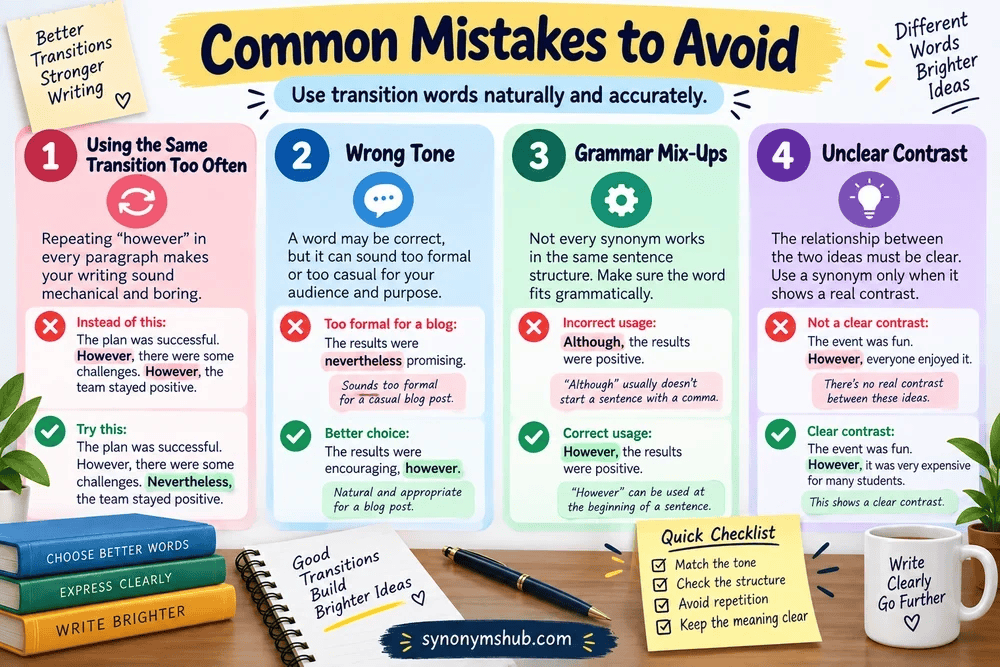
One common mistake is assuming that every synonym can replace “however” in the same way. It cannot. In fact, the wrong alternative can change the grammatical structure or even the relationship between your ideas.
| Common Mistake |
Why It Happens |
Better Approach |
| Treating every alternative as interchangeable |
Many contrast words perform different grammatical jobs |
Check whether you need a conjunction, adverb, or transition phrase |
| Replacing every “however” |
Writers assume variation is always necessary |
Keep “however” when it is already the clearest option |
| Overusing formal transitions |
Words such as “notwithstanding” may sound sophisticated |
Match the vocabulary to the audience and context |
| Using “on the contrary” for ordinary contrast |
It sounds similar to “on the other hand” |
Reserve it for direct contradiction |
| Starting every paragraph with a transition |
Transitional language can become mechanical |
Let some relationships remain clear without an explicit connector |
| Using “although” like a conjunctive adverb |
The grammar is different from “however” |
Join it to a dependent clause correctly |
| Choosing “conversely” without an opposite relationship |
It sounds academic and therefore tempting |
Use it only when the second point reverses the first |
| Repeating one replacement constantly |
One synonym simply replaces another repetitive word |
Rotate vocabulary only when meaning and tone support the change |
Conclusion
“However” is not a weak word. In many sentences, it is exactly the word you need. The problem appears when habit takes over. If every contrast begins with “however,” paragraphs can become predictable even when the ideas themselves are strong. Using Synonyms for however gives you more control over that rhythm.
A casual sentence may need nothing more than but. Research writing might call for nevertheless or by contrast. A balanced argument could use that said, while two truly opposite outcomes may be better connected with conversely. The difference is small on the page, yet it can change how naturally the reader follows your reasoning.
So, do not search for the most impressive replacement. Choose the one that makes the relationship between your ideas immediately clear.
FAQs
What Are Synonyms for However in an Essay?
Useful synonyms for however in an essay include nevertheless, nonetheless, yet, even so, in contrast, and that said, depending on the type of contrast.
What Are Synonyms for However to Start a Sentence?
Good synonyms for however to start a sentence include nevertheless, still, even so, that said, by contrast, and on the other hand.
What Are Synonyms for However in Academic Writing?
Common synonyms for however in academic writing include nevertheless, nonetheless, conversely, by contrast, despite this, and notwithstanding.
What Are Synonyms for the Word However?
Useful synonyms for the word however include but, yet, still, nevertheless, nonetheless, though, and even so.
What Are Synonyms for However Transition?
Popular synonyms for the however transition include nevertheless, on the other hand, in contrast, still, even so, and that said.
What Are Synonyms for However?
If you are asking what synonyms for however, some of the most natural choices are but, yet, still, nevertheless, nonetheless, and though.
What Are Synonyms for However in Writing?
The best synonyms for however in writing depend on tone, but yet, nevertheless, that said, in contrast, and even so work in many contexts.
What Are Synonyms for However Conjunction?
For conjunctions, you can use but, yet, although, and though, although “however” itself is usually a conjunctive adverb rather than a conjunction.
What Are Formal Synonyms for However?
Useful formal synonyms for however include nevertheless, nonetheless, notwithstanding, conversely, by contrast, and despite this.
What Are Synonyms for However in English?
Common synonyms for however in English include but, yet, still, though, nevertheless, nonetheless, and on the other hand.
What Are Some Synonyms for However?
If you wonder what some synonyms for however are, start with but, yet, still, even so, nevertheless, that said, and in contrast.