
Yeah, Bad is a word that we use nearly every day. A bad morning, a bad decision, bad weather or even a bad haircut may mean very different things. However, if the same word keeps recurring in your writing, it can become difficult to explain exactly what went wrong.
That’s where Synonyms for Bad come in handy. For instance, terrible is very bad, while poor is of low quality. Similarly, harmful implies that there is real harm, while disappointing connotes a lack of satisfaction as a result of not meeting expectations.
Selecting an alternate word is not just a way of making a sentence sound impressive. Rather, it is about comprehending the situation and using a statement that conveys your meaning. By learning Synonyms for Bad, you can enhance your writing in your essays, describe challenging situations, and express yourself more naturally in daily English.
What Do Synonyms for Bad Actually Mean?
Synonyms for Bad are words that refer to something negative, unpleasant, damaging, disappointing, or that is not up to a certain standard. While they may have a similar meaning, they are not necessarily used in the same ways. They are used as a function of what they’re describing and to what degree the description is expressed.
For example:
“The restaurant served bad food.”
You could also write:
“The restaurant served terrible food.”
Or:
“The restaurant served tasteless food.”
There are additional details given for both alternatives. Terrible implies a great deal of disapproval, and tasteless lets readers know how the food tastes.
Different alternatives for bad can express:
- Poor quality or unsatisfactory results
- Unpleasant experiences and feelings
- Harmful actions or dangerous situations
- Unacceptable behavior and poor judgment
- Serious mistakes and unfortunate outcomes
- Disappointing performances or experiences
- Dishonest, cruel, or morally wrong actions
- Weak performance or inadequate standards
Hence, the selection of the right option makes readers realize that something went wrong and why.
When to Use Synonyms for Bad
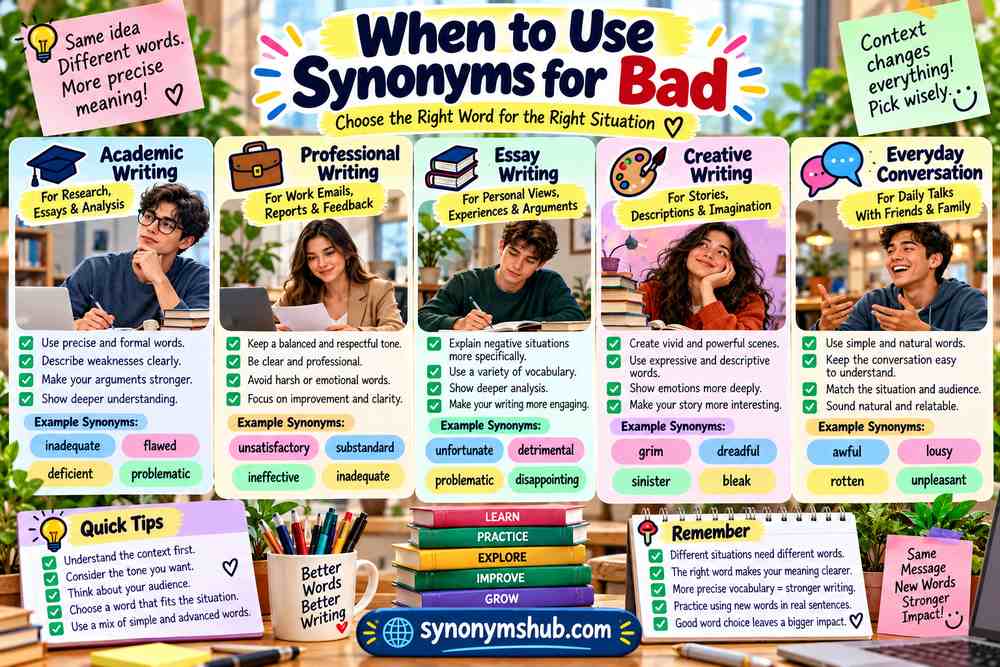
When using synonyms for bad, you can be more precise. This is especially true when describing problems, mistakes or bad experiences. But each alternative will have a different connotation and degree of intensity. What sounds fine in an informal chat might not seem like the right tone in a business report.
Academic Writing
A certain language is required when you are writing academic texts on weaknesses, limitations or unsuccessful results. For example, using the word inadequate, flawed, or deficient to describe a problem will be more precise than using the general word bad.
Professional Writing
Sensible and respectful language is generally a good way to communicate in the workplace. When referring to someone’s work, you could use unsatisfactory, substandard or ineffective instead of bad. Consequently, feedback is easier to understand and doesn’t feel personally negative.
Essay Writing
The essays are usually about assessing choices, experiences, and social issues. In addition, there are also alternatives like unfortunate, detrimental and problematic, which can be used to provide more precise and varied descriptions in negative contexts.
Creative Writing
Including descriptions that give a clear impression makes stories more interesting. Much more is conveyed to readers by a grim atmosphere, a dreadful experience or a sinister character than just by calling everything bad.
Everyday Conversation
Most of the time, use simple words when talking to others. For instance, in situations that are frustrating, you can use awful, lousy, rotten, and unpleasant. But it depends on your relationship with the listener and the severity of the situation.
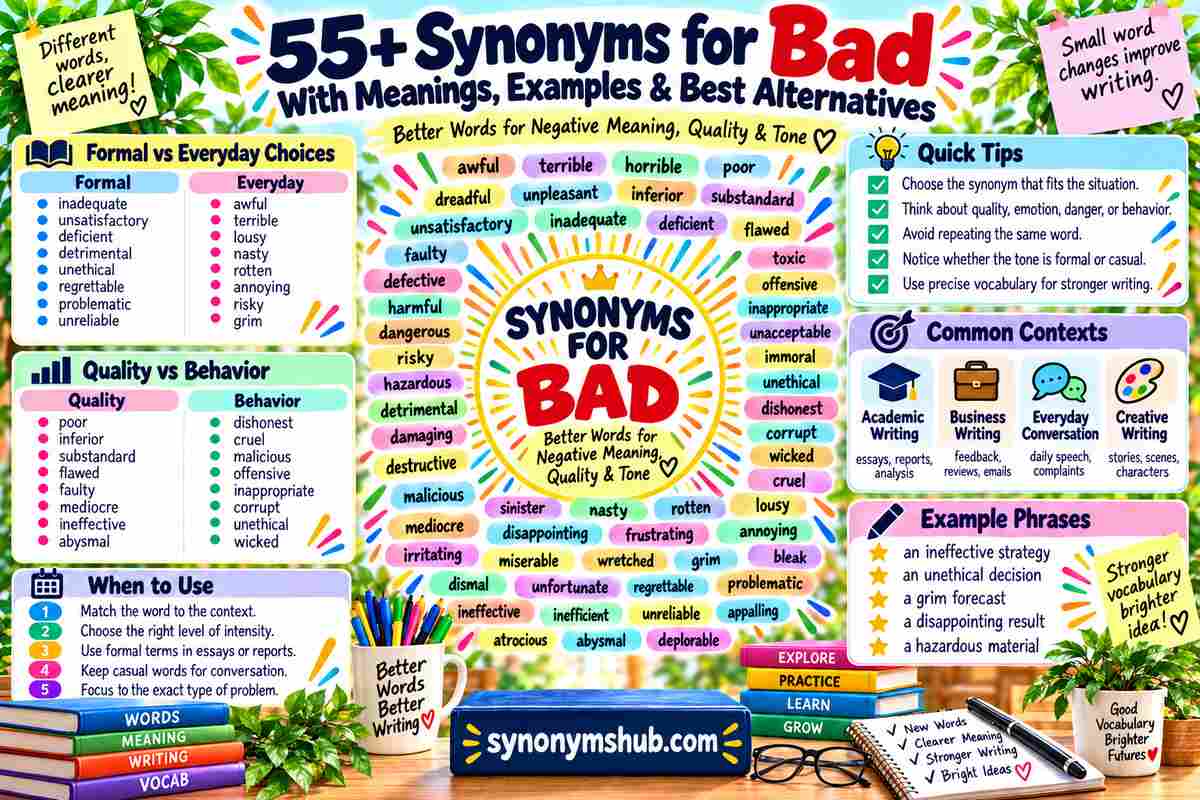
55+ Synonyms for Bad With Meanings, Examples & Best Alternatives
There are many Synonyms for Bad, but each one is a slightly different type of problem. Some say it’s bad quality, while others say danger, disappointment, dishonesty or bad feelings. There are 56 alternatives (meanings, tones, real-life examples, explanations, purposes, and related words) to help you choose confidently.
1. Awful
| Category | Details |
| Meaning | Extremely unpleasant, disappointing, or of very poor quality. |
| Tone | Strong, emotional, and informal. |
| Example | We had an awful experience at the hotel last weekend. |
| Explanation | Awful expresses strong dissatisfaction with an experience, situation, or result. |
| Purpose | Everyday conversations, personal stories, reviews, and complaints. |
| Best Alternatives | Terrible, dreadful, horrible, appalling. |
2. Terrible
| Category | Details |
| Meaning | Extremely bad, unpleasant, or serious. |
| Tone | Strong, direct, and expressive. |
| Example | The team made a terrible mistake during the final minutes. |
| Explanation | Terrible emphasizes how serious or unpleasant something is, often more strongly than bad. |
| Purpose | Conversations, storytelling, complaints, and descriptions of mistakes. |
| Best Alternatives | Awful, horrible, dreadful, disastrous. |
3. Horrible
| Category | Details |
| Meaning | Very unpleasant, frightening, or deeply upsetting. |
| Tone | Emotional, intense, and negative. |
| Example | She had a horrible headache throughout the journey. |
| Explanation | Horrible describes experiences that cause strong discomfort, distress, or disgust. |
| Purpose | Personal experiences, emotional writing, and everyday descriptions. |
| Best Alternatives | Awful, dreadful, terrible, appalling. |
4. Poor
| Category | Details |
| Meaning | Below an acceptable or expected level of quality. |
| Tone | Neutral, practical, and sometimes formal. |
| Example | Poor communication caused several problems during the project. |
| Explanation | Poor focuses on low standards rather than expressing strong emotional dislike. |
| Purpose | Academic writing, workplace feedback, evaluations, and reports. |
| Best Alternatives | Inferior, inadequate, substandard, unsatisfactory. |
5. Dreadful
| Category | Details |
| Meaning | Extremely unpleasant or causing strong feelings of distress. |
| Tone | Strong, expressive, and slightly dramatic. |
| Example | We experienced dreadful weather during our camping trip. |
| Explanation | Dreadful emphasizes serious discomfort or an especially unpleasant experience. |
| Purpose | Storytelling, travel descriptions, reviews, and emotional writing. |
| Best Alternatives | Terrible, awful, horrible, appalling. |
6. Unpleasant
| Category | Details |
| Meaning | Causing discomfort, dislike, or an uncomfortable feeling. |
| Tone | Polite, moderate, and descriptive. |
| Example | An unpleasant smell came from the kitchen sink. |
| Explanation | Unpleasant describes negative experiences without making them sound extremely serious. |
| Purpose | Professional communication, descriptions, reviews, and everyday English. |
| Best Alternatives | Disagreeable, uncomfortable, distasteful, offensive. |
7. Inferior
| Category | Details |
| Meaning | Lower in quality, value, or performance than something else. |
| Tone | Formal, comparative, and evaluative. |
| Example | The replacement material was inferior to the original fabric. |
| Explanation | Inferior is particularly useful when comparing the quality of two products or results. |
| Purpose | Product comparisons, technical reports, academic writing, and reviews. |
| Best Alternatives | Substandard, second-rate, poor, deficient. |
8. Substandard
| Category | Details |
| Meaning | Failing to meet an established or acceptable standard. |
| Tone | Formal, critical, and professional. |
| Example | Inspectors discovered substandard construction materials at the site. |
| Explanation | Substandard suggests a specific standard exists and the product or work falls below it. |
| Purpose | Quality inspections, business reports, evaluations, and professional writing. |
| Best Alternatives | Inferior, deficient, inadequate, unsatisfactory. |
9. Unsatisfactory
| Category | Details |
| Meaning | Not meeting expectations, requirements, or an acceptable level. |
| Tone | Formal, measured, and critical. |
| Example | The manager described the customer service response as unsatisfactory. |
| Explanation | Unsatisfactory communicates disapproval without using overly emotional language. |
| Purpose | Performance reviews, formal complaints, workplace emails, and evaluations. |
| Best Alternatives | Inadequate, disappointing, unacceptable, insufficient. |
10. Inadequate
| Category | Details |
| Meaning | Not sufficient or good enough for a particular purpose. |
| Tone | Formal, objective, and practical. |
| Example | The emergency supplies were inadequate for the number of visitors. |
| Explanation | Inadequate focuses on something failing to meet a particular need or requirement. |
| Purpose | Academic discussions, planning, research, reports, and professional assessments. |
| Best Alternatives | Insufficient, deficient, unsatisfactory, lacking. |
11. Deficient
| Category | Details |
| Meaning | Lacking something necessary for proper quality, function, or performance. |
| Tone | Technical, formal, and analytical. |
| Example | The safety report revealed that several procedures were deficient. |
| Explanation | Deficient identifies an important weakness or missing requirement in a system or process. |
| Purpose | Technical writing, inspections, academic research, and quality evaluations. |
| Best Alternatives | Inadequate, insufficient, lacking, incomplete. |
12. Flawed
| Category | Details |
| Meaning | Containing mistakes, weaknesses, or imperfections. |
| Tone | Analytical, critical, and professional. |
| Example | The committee rejected the proposal because its financial assumptions were flawed. |
| Explanation | Flawed suggests something may have useful qualities but contains problems that affect its reliability. |
| Purpose | Research papers, critical reviews, arguments, and business discussions. |
| Best Alternatives | Defective, imperfect, faulty, unsound. |
13. Faulty
| Category | Details |
| Meaning | Containing a defect or working incorrectly. |
| Tone | Practical, technical, and objective. |
| Example | A faulty sensor caused the machine to stop unexpectedly. |
| Explanation | Faulty usually describes equipment, reasoning, systems, or processes that do not function correctly. |
| Purpose | Technical reports, product complaints, maintenance records, and explanations. |
| Best Alternatives | Defective, malfunctioning, flawed, unreliable. |
14. Defective
| Category | Details |
| Meaning | Having a physical or functional fault that prevents proper operation. |
| Tone | Technical, precise, and formal. |
| Example | The company recalled several defective charging cables. |
| Explanation | Defective identifies products or components with problems affecting their intended function. |
| Purpose | Manufacturing, product safety, quality control, and customer complaints. |
| Best Alternatives | Faulty, damaged, imperfect, malfunctioning. |
15. Harmful
| Category | Details |
| Meaning | Causing damage, injury, or negative consequences. |
| Tone | Serious, direct, and cautionary. |
| Example | Excessive noise can be harmful to people’s hearing. |
| Explanation | Harmful emphasizes actual or potential damage rather than simple dissatisfaction. |
| Purpose | Health discussions, environmental writing, safety guidance, and education. |
| Best Alternatives | Damaging, detrimental, injurious, destructive. |
16. Dangerous
| Category | Details |
| Meaning | Likely to cause injury, harm, or serious problems. |
| Tone | Serious, urgent, and cautionary. |
| Example | Driving through the mountains during the storm was dangerous. |
| Explanation | Dangerous highlights the possibility of harm, even when no injury has occurred. |
| Purpose | Safety instructions, warnings, news reports, and everyday communication. |
| Best Alternatives | Hazardous, risky, perilous, unsafe. |
17. Risky
| Category | Details |
| Meaning | Involving the possibility of loss, failure, or harm. |
| Tone | Cautious, practical, and conversational. |
| Example | Investing all his savings in one business was a risky decision. |
| Explanation | Risky focuses on uncertainty and the possibility of an unfavorable outcome. |
| Purpose | Financial discussions, decision-making, business writing, and advice. |
| Best Alternatives | Dangerous, hazardous, uncertain, precarious. |
18. Hazardous
| Category | Details |
| Meaning | Presenting a serious risk to health, safety, or the environment. |
| Tone | Formal, technical, and cautionary. |
| Example | Workers must wear protective equipment when handling hazardous chemicals. |
| Explanation | Hazardous is commonly used when discussing materials, environments, or conditions that may cause harm. |
| Purpose | Workplace safety, environmental reports, technical documents, and warnings. |
| Best Alternatives | Dangerous, unsafe, perilous, harmful. |
Read more: 50+ Synonyms for Big With Meanings & Real Examples
19. Detrimental
| Category | Details |
| Meaning | Causing harm or having an unfavorable effect on something. |
| Tone | Formal, analytical, and serious. |
| Example | Poor sleep habits can be detrimental to academic performance. |
| Explanation | Detrimental describes negative effects on progress, well-being, performance, or development. |
| Purpose | Academic essays, research papers, professional reports, and evaluations. |
| Best Alternatives | Harmful, damaging, adverse, injurious. |
20. Damaging
| Category | Details |
| Meaning | Causing physical, emotional, financial, or reputational harm. |
| Tone | Serious, descriptive, and critical. |
| Example | The false accusations had a damaging effect on her reputation. |
| Explanation | Damaging focuses on the negative consequences of an action or situation. |
| Purpose | News writing, workplace discussions, reports, and social commentary. |
| Best Alternatives | Harmful, destructive, detrimental, injurious. |
21. Destructive
| Category | Details |
| Meaning | Causing severe damage, disruption, or destruction. |
| Tone | Powerful, serious, and alarming. |
| Example | The destructive storm damaged several buildings along the coast. |
| Explanation | Destructive suggests serious harm that may affect property, relationships, systems, or the environment. |
| Purpose | Environmental writing, news reports, emotional descriptions, and social issues. |
| Best Alternatives | Devastating, ruinous, damaging, harmful. |
22. Toxic
| Category | Details |
| Meaning | Poisonous or seriously harmful to physical or emotional well-being. |
| Tone | Strong, critical, and sometimes informal. |
| Example | The toxic workplace atmosphere made employees feel constantly stressed. |
| Explanation | Toxic can describe poisonous substances as well as relationships or environments that cause ongoing harm. |
| Purpose | Health discussions, relationship advice, workplace issues, and social commentary. |
| Best Alternatives | Poisonous, harmful, unhealthy, corrosive. |
23. Offensive
| Category | Details |
| Meaning | Causing anger, hurt, disgust, or a sense of disrespect. |
| Tone | Critical, serious, and socially sensitive. |
| Example | Several guests complained about the offensive remarks made during dinner. |
| Explanation | Offensive describes language or behavior that people find insulting, disrespectful, or deeply unpleasant. |
| Purpose | Social discussions, communication guidelines, formal complaints, and journalism. |
| Best Alternatives | Insulting, disrespectful, objectionable, inappropriate. |
24. Inappropriate
| Category | Details |
| Meaning | Not suitable or acceptable for a particular situation. |
| Tone | Polite, professional, and corrective. |
| Example | His inappropriate comments made the formal meeting uncomfortable. |
| Explanation | Inappropriate focuses on behavior or language that does not fit the occasion or expected standards. |
| Purpose | Workplace communication, education, formal feedback, and social situations. |
| Best Alternatives | Unsuitable, improper, unacceptable, unseemly. |
25. Unacceptable
| Category | Details |
| Meaning | Not meeting required standards or reasonable expectations. |
| Tone | Firm, serious, and authoritative. |
| Example | The supervisor explained that repeated safety violations were unacceptable. |
| Explanation | Unacceptable expresses a clear refusal to tolerate a particular standard, action, or result. |
| Purpose | Business policies, professional complaints, disciplinary discussions, and formal writing. |
| Best Alternatives | Intolerable, inappropriate, unsatisfactory, objectionable. |
26. Immoral
| Category | Details |
| Meaning | Violating accepted principles of right and wrong. |
| Tone | Serious, ethical, and judgmental. |
| Example | Many people considered the exploitation of vulnerable workers immoral. |
| Explanation | Immoral describes actions that conflict with ethical beliefs or moral standards. |
| Purpose | Ethics essays, philosophical discussions, social issues, and critical analysis. |
| Best Alternatives | Unethical, wicked, corrupt, dishonorable. |
27. Unethical
| Category | Details |
| Meaning | Going against accepted standards of honest or responsible conduct. |
| Tone | Formal, professional, and critical. |
| Example | Sharing confidential customer information was an unethical business practice. |
| Explanation | Unethical is particularly useful when evaluating professional conduct, fairness, or responsibilities. |
| Purpose | Business ethics, academic writing, professional policies, and legal discussions. |
| Best Alternatives | Immoral, dishonest, improper, corrupt. |
28. Dishonest
| Category | Details |
| Meaning | Not truthful or willing to deceive others. |
| Tone | Direct, critical, and moral. |
| Example | The salesperson was dishonest about the product’s condition. |
| Explanation | Dishonest specifically identifies deception, misleading information, or a lack of truthfulness. |
| Purpose | Character descriptions, business complaints, ethical discussions, and storytelling. |
| Best Alternatives | Deceitful, fraudulent, untruthful, misleading. |
29. Corrupt
| Category | Details |
| Meaning | Acting dishonestly or abusing power for personal advantage. |
| Tone | Strong, serious, and accusatory. |
| Example | Investigators uncovered a corrupt arrangement involving public contracts. |
| Explanation | Corrupt often describes serious dishonesty within organizations, institutions, or positions of authority. |
| Purpose | Political analysis, investigative journalism, legal writing, and social commentary. |
| Best Alternatives | Dishonest, unethical, fraudulent, crooked. |
30. Wicked
| Category | Details |
| Meaning | Morally evil or deliberately cruel. |
| Tone | Strong, dramatic, and moral. |
| Example | The novel tells the story of a wicked ruler who mistreated his people. |
| Explanation | Wicked emphasizes moral wrongdoing, although it can also mean excellent in some informal varieties of English. |
| Purpose | Literature, storytelling, character descriptions, and moral discussions. |
| Best Alternatives | Evil, cruel, immoral, malicious. |
31. Cruel
| Category | Details |
| Meaning | Causing suffering or showing little concern for others’ pain. |
| Tone | Emotional, serious, and condemning. |
| Example | The cruel treatment of the abandoned animals upset the local community. |
| Explanation | Cruel describes harmful behavior involving a lack of compassion or unnecessary suffering. |
| Purpose | Social issues, literature, ethical discussions, and emotional storytelling. |
| Best Alternatives | Heartless, brutal, merciless, unkind. |
32. Malicious
| Category | Details |
| Meaning | Intending to hurt, embarrass, or cause harm to someone. |
| Tone | Formal, severe, and accusatory. |
| Example | Someone spread malicious rumors about the new employee. |
| Explanation | Malicious emphasizes harmful intention rather than an accidental mistake or careless action. |
| Purpose | Legal discussions, workplace complaints, journalism, and character analysis. |
| Best Alternatives | Spiteful, malevolent, vindictive, harmful. |
33. Sinister
| Category | Details |
| Meaning | Suggesting something threatening, evil, or potentially harmful. |
| Tone | Dark, suspenseful, and dramatic. |
| Example | A sinister figure appeared near the abandoned house after midnight. |
| Explanation | Sinister creates an atmosphere of danger, mystery, or threatening intentions. |
| Purpose | Mystery stories, horror writing, film reviews, and character descriptions. |
| Best Alternatives | Menacing, ominous, threatening, malevolent. |
34. Nasty
| Category | Details |
| Meaning | Very unpleasant, mean, or disagreeable. |
| Tone | Informal, strong, and expressive. |
| Example | He made a nasty remark about his colleague’s presentation. |
| Explanation | Nasty can describe unpleasant behavior, experiences, smells, or physical conditions. |
| Purpose | Everyday conversations, informal complaints, storytelling, and descriptions. |
| Best Alternatives | Mean, unpleasant, spiteful, horrible. |
35. Rotten
| Category | Details |
| Meaning | Decayed, spoiled, or extremely unpleasant. |
| Tone | Informal, expressive, and descriptive. |
| Example | The children discovered rotten apples behind the storage shed. |
| Explanation | Rotten literally describes decay, but it can also refer to unpleasant situations or dishonest behavior. |
| Purpose | Food descriptions, casual conversations, stories, and informal criticism. |
| Best Alternatives | Spoiled, decayed, foul, miserable. |
36. Lousy
| Category | Details |
| Meaning | Very poor in quality or highly unsatisfactory. |
| Tone | Casual, blunt, and conversational. |
| Example | We received lousy service despite booking our table in advance. |
| Explanation | Lousy is a familiar informal expression for something that fails to meet expectations. |
| Purpose | Casual conversations, personal reviews, informal complaints, and storytelling. |
| Best Alternatives | Poor, awful, terrible, second-rate. |
37. Mediocre
| Category | Details |
| Meaning | Only average in quality and not particularly impressive. |
| Tone | Critical, measured, and evaluative. |
| Example | Despite its impressive advertising, the movie received mediocre reviews. |
| Explanation | Mediocre describes something ordinary or unimpressive rather than extremely terrible. |
| Purpose | Reviews, academic evaluations, performance discussions, and professional feedback. |
| Best Alternatives | Average, unimpressive, ordinary, second-rate. |
38. Disappointing
| Category | Details |
| Meaning | Failing to meet someone’s hopes or expectations. |
| Tone | Moderate, personal, and evaluative. |
| Example | The disappointing exam results encouraged her to change her study routine. |
| Explanation | Disappointing focuses on the difference between what someone expected and what actually happened. |
| Purpose | Performance reviews, personal experiences, evaluations, and everyday conversations. |
| Best Alternatives | Unsatisfactory, underwhelming, discouraging, frustrating. |
39. Frustrating
| Category | Details |
| Meaning | Causing annoyance because something is difficult or unsuccessful. |
| Tone | Emotional, conversational, and expressive. |
| Example | It was frustrating to wait several hours without receiving an update. |
| Explanation | Frustrating describes situations that prevent progress or repeatedly test someone’s patience. |
| Purpose | Personal experiences, customer feedback, workplace discussions, and conversations. |
| Best Alternatives | Annoying, irritating, discouraging, exasperating. |
40. Annoying
| Category | Details |
| Meaning | Causing mild anger, irritation, or inconvenience. |
| Tone | Informal, direct, and familiar. |
| Example | The annoying buzzing sound made it difficult to concentrate. |
| Explanation | Annoying usually describes everyday problems that irritate rather than seriously harm someone. |
| Purpose | Casual communication, personal complaints, and descriptions of minor problems. |
| Best Alternatives | Irritating, bothersome, frustrating, aggravating. |
41. Irritating
| Category | Details |
| Meaning | Causing repeated annoyance or physical discomfort. |
| Tone | Direct, descriptive, and moderately negative. |
| Example | The irritating noise from the construction site continued all morning. |
| Explanation | Irritating suggests ongoing discomfort or annoyance that becomes difficult to ignore. |
| Purpose | Daily conversations, product reviews, workplace complaints, and descriptions. |
| Best Alternatives | Annoying, aggravating, bothersome, exasperating. |
42. Miserable
| Category | Details |
| Meaning | Extremely unhappy, uncomfortable, or unpleasant. |
| Tone | Emotional, strong, and descriptive. |
| Example | The hikers felt miserable after spending hours in the cold rain. |
| Explanation | Miserable often describes a person’s emotional or physical discomfort, although it can also describe unpleasant conditions. |
| Purpose | Personal stories, emotional writing, travel experiences, and everyday English. |
| Best Alternatives | Unhappy, wretched, gloomy, distressed. |
43. Wretched
| Category | Details |
| Meaning | Extremely unpleasant, miserable, or of very poor quality. |
| Tone | Literary, emotional, and intense. |
| Example | The refugees endured wretched living conditions during the winter. |
| Explanation | Wretched emphasizes severe hardship, suffering, or conditions far below an acceptable standard. |
| Purpose | Literary writing, historical descriptions, social commentary, and emotional storytelling. |
| Best Alternatives | Miserable, deplorable, dreadful, pitiful. |
44. Grim
| Category | Details |
| Meaning | Serious, depressing, or suggesting an unfavorable outcome. |
| Tone | Serious, dark, and realistic. |
| Example | The rescue team faced grim conditions after the earthquake. |
| Explanation | Grim describes situations that feel harsh, discouraging, or difficult to overcome. |
| Purpose | News reports, literature, serious discussions, and descriptions of difficult situations. |
| Best Alternatives | Bleak, gloomy, harsh, dismal. |
45. Bleak
| Category | Details |
| Meaning | Offering little hope, comfort, or encouragement. |
| Tone | Somber, pessimistic, and descriptive. |
| Example | The company’s financial outlook remained bleak after several unsuccessful quarters. |
| Explanation | Bleak suggests a discouraging situation with limited signs of improvement. |
| Purpose | Economic reports, weather descriptions, literature, and serious analysis. |
| Best Alternatives | Grim, gloomy, hopeless, dismal. |
46. Dismal
| Category | Details |
| Meaning | Extremely disappointing, depressing, or lacking in success. |
| Tone | Strong, critical, and descriptive. |
| Example | The restaurant recorded dismal sales during its opening month. |
| Explanation | Dismal often describes poor results, discouraging conditions, or gloomy surroundings. |
| Purpose | Business reports, sports commentary, reviews, and descriptive writing. |
| Best Alternatives | Bleak, depressing, miserable, disappointing. |
47. Unfortunate
| Category | Details |
| Meaning | Causing regret, disappointment, or an undesirable outcome. |
| Tone | Polite, sympathetic, and measured. |
| Example | An unfortunate scheduling mistake delayed the conference. |
| Explanation | Unfortunate communicates that something negative happened without necessarily assigning blame. |
| Purpose | Professional emails, formal announcements, personal messages, and reports. |
| Best Alternatives | Regrettable, unlucky, disappointing, adverse. |
48. Regrettable
| Category | Details |
| Meaning | Causing disappointment, sadness, or feelings of regret. |
| Tone | Formal, respectful, and reflective. |
| Example | The director acknowledged the regrettable delay in delivering the project. |
| Explanation | Regrettable is useful when describing mistakes or outcomes that should not have happened. |
| Purpose | Apologies, professional statements, formal letters, and official communication. |
| Best Alternatives | Unfortunate, disappointing, lamentable, undesirable. |
49. Problematic
| Category | Details |
| Meaning | Creating difficulties, concerns, or possible negative consequences. |
| Tone | Analytical, moderate, and critical. |
| Example | The research team identified several problematic assumptions in the original model. |
| Explanation | Problematic identifies something that raises concerns or needs closer examination. |
| Purpose | Academic writing, research discussions, workplace evaluations, and critical essays. |
| Best Alternatives | Flawed, questionable, troublesome, contentious. |
50. Ineffective
| Category | Details |
| Meaning | Failing to produce the intended or expected result. |
| Tone | Objective, professional, and analytical. |
| Example | The advertising campaign was ineffective at attracting new customers. |
| Explanation | Ineffective focuses on the failure of a method, action, or strategy to achieve its purpose. |
| Purpose | Business reports, research evaluations, educational discussions, and performance reviews. |
| Best Alternatives | Unsuccessful, inefficient, inadequate, unproductive. |
51. Inefficient
| Category | Details |
| Meaning | Using more time, money, or resources than necessary. |
| Tone | Professional, practical, and critical. |
| Example | The inefficient booking system forced customers to repeat the same information. |
| Explanation | Inefficient identifies wasteful processes, even when they eventually produce the desired result. |
| Purpose | Business analysis, operational reviews, project management, and technical writing. |
| Best Alternatives | Wasteful, unproductive, cumbersome, poorly organized. |
52. Unreliable
| Category | Details |
| Meaning | Not consistently trustworthy, dependable, or accurate. |
| Tone | Critical, practical, and cautionary. |
| Example | The unreliable internet connection interrupted several online meetings. |
| Explanation | Unreliable describes people, information, equipment, or services that cannot be depended upon consistently. |
| Purpose | Product reviews, workplace feedback, technical reports, and everyday discussions. |
| Best Alternatives | Undependable, inconsistent, unpredictable, untrustworthy. |
53. Appalling
| Category | Details |
| Meaning | Shockingly bad or causing strong feelings of disgust or disapproval. |
| Tone | Very strong, emotional, and condemnatory. |
| Example | Inspectors were shocked by the appalling conditions inside the overcrowded shelter. |
| Explanation | Appalling expresses stronger criticism than ordinary dissatisfaction because the situation seems shocking. |
| Purpose | Investigative reports, social commentary, formal criticism, and emotional writing. |
| Best Alternatives | Shocking, dreadful, atrocious, disgraceful. |
54. Atrocious
| Category | Details |
| Meaning | Extremely bad in quality or shockingly cruel. |
| Tone | Intense, critical, and forceful. |
| Example | The poorly maintained road was in atrocious condition after the flooding. |
| Explanation | Atrocious communicates an extreme degree of poor quality or unacceptable behavior. |
| Purpose | Strong criticism, news writing, social issues, and descriptive storytelling. |
| Best Alternatives | Appalling, terrible, dreadful, abysmal. |
55. Abysmal
| Category | Details |
| Meaning | Extremely poor in quality, performance, or standard. |
| Tone | Strong, critical, and evaluative. |
| Example | The company’s abysmal customer satisfaction rating prompted an urgent review. |
| Explanation | Abysmal describes exceptionally poor results, often suggesting performance near the lowest possible level. |
| Purpose | Business reviews, performance evaluations, academic criticism, and journalism. |
| Best Alternatives | Atrocious, appalling, dreadful, disastrous. |
56. Deplorable
| Category | Details |
| Meaning | Shockingly poor or deserving strong criticism and disapproval. |
| Tone | Formal, severe, and condemning. |
| Example | The investigation revealed deplorable working conditions at the factory. |
| Explanation | Deplorable is often used when unacceptable conditions or behavior raise serious moral or social concerns. |
| Purpose | Human rights discussions, investigative journalism, formal criticism, and social commentary. |
| Best Alternatives | Appalling, disgraceful, shameful, unacceptable. |
Which Synonyms for Bad Should You Choose Effectively?
The appropriate option will depend upon the situation, level of intensity, and message to be conveyed. For instance, poor is used for a minor quality problem, but appalling is a much harsher criticism. Hence, the proper use of Synonyms for Bad can help to make the writing clear and suitable for various audiences.
| Situation | Best Synonyms |
| Formal Writing | Unsatisfactory, Inadequate, Deficient, Regrettable |
| Academic Writing | Flawed, Problematic, Detrimental, Ineffective |
| Professional Communication | Unsatisfactory, Substandard, Inadequate, Unacceptable |
| Casual Conversation | Awful, Terrible, Lousy, Nasty |
| Strong Criticism | Appalling, Atrocious, Abysmal, Deplorable |
| Poor Quality | Inferior, Substandard, Defective, Mediocre |
| Negative Emotions | Miserable, Frustrating, Annoying, Irritating |
| Harmful Situations | Dangerous, Hazardous, Toxic, Destructive |
| Moral Wrongdoing | Immoral, Unethical, Dishonest, Corrupt |
| Creative Writing | Sinister, Grim, Bleak, Wretched |
| Disappointing Results | Dismal, Unsatisfactory, Ineffective, Mediocre |
| Unfortunate Events | Regrettable, Unfortunate, Dreadful, Disappointing |
Common Mistakes to Avoid When Using Synonyms for Bad
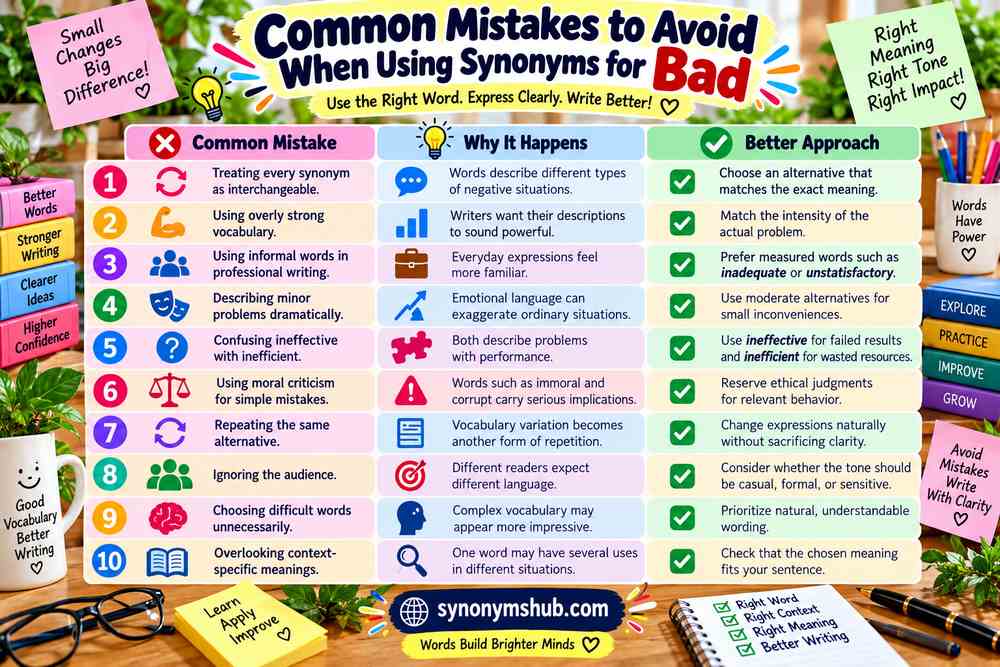
Changing the words in your writing can strengthen your piece. However, you can change the words without being mindful of that change, which can alter the meaning of your sentence. Many alternatives have the same negative connotation, but express varying degrees of seriousness, emotion and criticism.
| Common Mistake | Why It Happens | Better Approach |
| Treating every synonym as interchangeable | Words describe different types of negative situations | Choose an alternative that matches the exact meaning |
| Using overly strong vocabulary | Writers want their descriptions to sound powerful | Match the intensity of the actual problem |
| Using informal words in professional writing | Everyday expressions feel more familiar | Prefer measured words such as inadequate or unsatisfactory |
| Describing minor problems dramatically | Emotional language can exaggerate ordinary situations | Use moderate alternatives for small inconveniences |
| Confusing ineffective with inefficient | Both describe problems with performance | Use ineffective for failed results and inefficient for wasted resources |
| Using moral criticism for simple mistakes | Words such as immoral and corrupt carry serious implications | Reserve ethical judgments for relevant behavior |
| Repeating the same alternative | Vocabulary variation becomes another form of repetition | Change expressions naturally without sacrificing clarity |
| Ignoring the audience | Different readers expect different language | Consider whether the tone should be casual, formal, or sensitive |
| Choosing difficult words unnecessarily | Complex vocabulary may appear more impressive | Prioritize natural, understandable wording |
| Overlooking context-specific meanings | One word may have several uses | Check that the chosen meaning fits your sentence |
Conclusion
Bad is a great word since it can be used for nearly anything that is negative. But overusing it can make it more difficult to precisely define a problem. The Synonyms for Bad list allows you to have additional options for expressing disappointment, poor quality, discomfort, danger, or unacceptable behavior.
A restaurant may have poor service, a company may pursue an unsuccessful marketing plan, and a machine may be faulty, which can cause dangerous conditions. While these all have a negative aspect, each alternative shows a different type of problem.
From your essay to a professional report, story or everyday use, the right word can make a difference. Finally, good writing is not the most complicated expression. It is the word that conveys your message.
Frequently Asked Questions
What are other words for bad?
Common alternatives include awful, terrible, horrible, poor, dreadful, unpleasant, inferior, and disappointing. However, the best choice depends on whether you’re describing quality, behavior, feelings, or a particular situation.
What is a useful list of synonyms for bad?
A useful list includes awful, terrible, horrible, poor, dreadful, unpleasant, harmful, dangerous, faulty, flawed, inferior, substandard, and appalling. Each word expresses a different type or degree of negativity.
What are 3 synonyms for bad?
Three simple synonyms for bad are awful, terrible, and poor. While awful expresses strong dissatisfaction, poor commonly describes something below an expected standard.
What are synonyms for bad for kids?
Easy alternatives for children include awful, terrible, poor, unpleasant, nasty, and rotten. These words are relatively simple to understand and can help kids describe everyday problems more clearly.
What is the best situation to use a synonym for bad?
There isn’t one perfect replacement for bad in every situation. For instance, terrible suits an unpleasant experience, poor describes low quality, and harmful refers to something that causes damage.