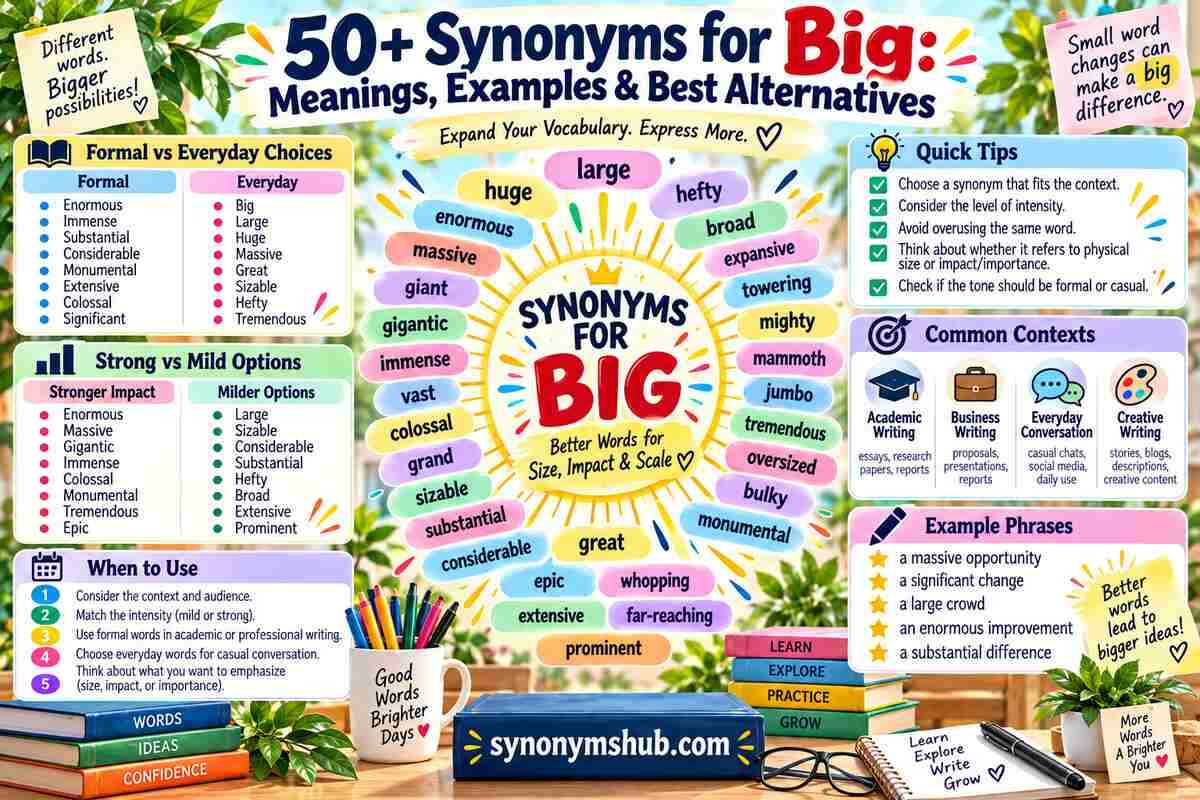
Usually, Big does a lot of heavy lifting in everyday English. We reach for it constantly: big house, big decision, big problem, big win. It works fine most of the time. But when you’re writing something that needs to hold a reader’s attention, using it over and over starts to flatten everything out. Every sentence ends up sounding roughly the same size, roughly the same weight.
That’s the real reason to come up with Synonyms for Big stand out. It’s not to sound fancier, but to actually say what you mean. A house can be large, or it can be spacious, and those aren’t the same compliment. One’s about square footage; the other’s about how it feels to be inside it. A decision can be big, sure, but calling it significant tells the reader something about its consequences, not just its size.
As a result, a wider vocabulary can make conversations and writing clearer, more natural, more precise and more relevant to its context.
What Do Synonyms for Big Actually Mean?
The phrase Synonyms for Big covers words that can convey five or six different ideas depending on the sentence. Sometimes it’s about physical size. Sometimes it’s importance. Sometimes it’s quantity, or influence, or how strongly something hits you emotionally. Although many of these words are related, they are not interchangeable in every sentence.
For example:
“They bought a big house.”
You could write:
“They bought a large house.”
Or:
“They bought a spacious house.”
All three sentences suggest size, but the emphasis changes. Large focuses mainly on dimensions, while spacious suggests that the house has plenty of usable room.
Similarly:
“It was a big decision.”
A stronger version could be:
“It was a significant decision.”
Here, significant refers to importance rather than physical size.
Broadly, the words people reach for instead of “big” tend to cover:
- Physical size or dimensions
- Large quantities
- Distance or area
- Importance
- Influence or authority
- Strength of effect
- Seriousness of a problem
- Scale of an achievement
- Intensity of emotion
- Wealth, success, or reputation
The right word isn’t sitting in a thesaurus waiting to be picked at random. Yeah, it depends entirely on which of those meanings your sentence actually needs.
When to Use Synonyms for Big
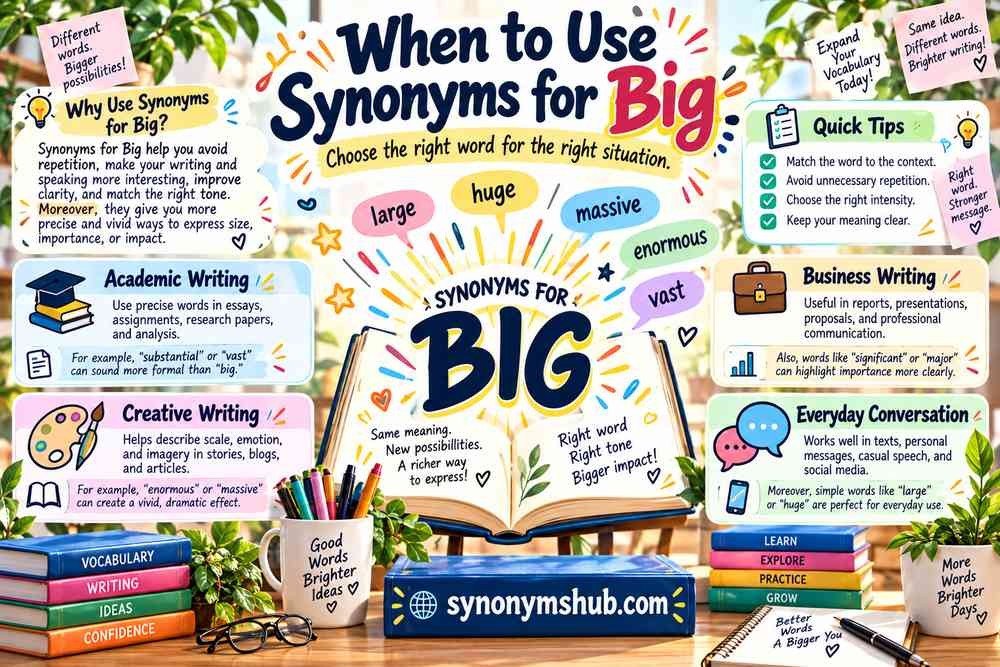
Use Synonyms for Big when you want to make your writing more specific, descriptive, and natural. However, swapping the word alone isn’t the whole job. Yeah, each option leans toward a different meaning, so it matters whether you’re really talking about size, importance, quantity, influence, or how strongly something hit you.
A few places where it’s worth the extra thought:
Academic Writing
You may use them in research papers, essays, and analysis tend to read better with more exact language. “Significant,” “substantial,” “extensive,” and “considerable” all say more than “big” does, and they’re the kind of words readers expect in formal work.
Business Writing
This is where “big” starts to sound a little casual for the room in Reports, proposals, performance reviews and presentations. “Major,” “substantial,” and “considerable” carry the same idea but land with more weight than simply using big.
Creative Writing
Creative stories, travel writing, blog posts, reviews anywhere the goal is to help someone picture what you’re describing. “Gigantic,” “colossal,” “towering,” and “grand” are words that do actual imagery work that “big” just can’t.
Everyday Conversation
We use these words in personal messages, social media posts, and casual discussions. Simple alternatives such as large, huge, massive, and great usually sound natural and are easy to understand.
50+ Synonyms for Big With Different Meanings, Examples & Best Alternatives
The list of synonyms for Big below covers size, importance, quantity, influence, and intensity depending on context. Each word here leans a certain direction. So the short explanation next to each one is meant to help you spot where it actually fits, rather than just picking whichever sounds most impressive.
1. Large
| Category |
Details |
| Meaning |
Greater than average in size, amount, or extent. |
| Tone |
Neutral and widely used. |
| Example |
They rented a large apartment near the city center. |
| Explanation |
Large is one of the most direct and natural replacements for big when discussing physical size. |
| Purpose |
Everyday conversation, essays, reports, and descriptions. |
| Best Alternatives |
Huge, substantial, spacious, extensive |
2. Huge
| Category |
Details |
| Meaning |
Extremely large in size, amount, or importance. |
| Tone |
Strong, informal, and expressive. |
| Example |
The announcement created a huge amount of excitement. |
| Explanation |
Huge expresses greater size or intensity than large. Therefore, it works well when you want emphasis. |
| Purpose |
Casual speech, storytelling, social media, and informal writing. |
| Best Alternatives |
Enormous, massive, tremendous, gigantic |
3. Enormous
| Category |
Details |
| Meaning |
Extremely large in size, quantity, or degree. |
| Tone |
Strong and descriptive. |
| Example |
The project required an enormous amount of planning. |
| Explanation |
Enormous emphasizes something far beyond normal size or quantity. |
| Purpose |
Essays, descriptions, reports, and creative writing. |
| Best Alternatives |
Immense, huge, colossal, massive |
4. Massive
| Category |
Details |
| Meaning |
Very large, heavy, extensive, or powerful. |
| Tone |
Strong and dramatic. |
| Example |
A massive crowd gathered outside the stadium. |
| Explanation |
Massive often suggests both size and weight. However, it can also describe large-scale effects or changes. |
| Purpose |
News writing, descriptions, conversation, and storytelling. |
| Best Alternatives |
Huge, enormous, mammoth, immense |
5. Gigantic
| Category |
Details |
| Meaning |
Extremely large, especially in physical size. |
| Tone |
Dramatic and vivid. |
| Example |
A gigantic statue stood at the entrance to the park. |
| Explanation |
Gigantic creates a strong visual impression and is particularly useful for unusually large objects. |
| Purpose |
Creative writing, storytelling, and descriptive language. |
| Best Alternatives |
Colossal, enormous, mammoth, huge |
6. Immense
| Category |
Details |
| Meaning |
Extremely large in size, extent, or degree. |
| Tone |
Formal and expressive. |
| Example |
She felt immense relief after receiving the results. |
| Explanation |
Immense can describe physical size as well as feelings, effort, value, or importance. |
| Purpose |
Formal writing, essays, emotional descriptions, and literature. |
| Best Alternatives |
Vast, enormous, tremendous, substantial |
7. Vast
| Category |
Details |
| Meaning |
Extremely large in area, extent, amount, or range. |
| Tone |
Formal and descriptive. |
| Example |
The country contains vast areas of untouched forest. |
| Explanation |
Vast is especially useful for landscapes, distances, knowledge, and large quantities. |
| Purpose |
Academic writing, travel writing, reports, and descriptions. |
| Best Alternatives |
Extensive, expansive, immense, broad |
8. Colossal
| Category |
Details |
| Meaning |
Extremely large or impressive. |
| Tone |
Dramatic and powerful. |
| Example |
Building the bridge was a colossal engineering challenge. |
| Explanation |
Colossal often emphasizes extraordinary size or difficulty. For instance, it can describe projects, buildings, mistakes, or achievements. |
| Purpose |
Creative writing, journalism, and dramatic descriptions. |
| Best Alternatives |
Gigantic, mammoth, enormous, monumental |
9. Mammoth
| Category |
Details |
| Meaning |
Extremely large or demanding. |
| Tone |
Strong and slightly informal. |
| Example |
Organizing the international event became a mammoth task. |
| Explanation |
Mammoth is often used figuratively for projects, responsibilities, and difficult jobs. |
| Purpose |
Journalism, business writing, and informal descriptions. |
| Best Alternatives |
Colossal, massive, gigantic, monumental |
10. Tremendous
| Category |
Details |
| Meaning |
Very great in amount, degree, strength, or importance. |
| Tone |
Strong and positive or neutral. |
| Example |
The team made tremendous progress during the season. |
| Explanation |
Tremendous often describes improvement, effort, influence, or success instead of literal physical size. |
| Purpose |
Professional writing, speeches, essays, and conversation. |
| Best Alternatives |
Immense, remarkable, considerable, great |
11. Substantial
| Category |
Details |
| Meaning |
Large in amount, value, size, or importance. |
| Tone |
Formal and professional. |
| Example |
The company made a substantial investment in new technology. |
| Explanation |
Substantial works particularly well with money, growth, evidence, changes, and resources. |
| Purpose |
Academic, business, financial, and professional writing. |
| Best Alternatives |
Considerable, significant, major, sizeable |
12. Considerable
| Category |
Details |
| Meaning |
Large enough to be important or noticeable. |
| Tone |
Formal and measured. |
| Example |
The renovation required considerable time and effort. |
| Explanation |
Considerable is useful when something is clearly large without sounding exaggerated. |
| Purpose |
Reports, essays, research, and professional communication. |
| Best Alternatives |
Substantial, significant, extensive, major |
13. Extensive
| Category |
Details |
| Meaning |
Covering a large area, range, amount, or subject. |
| Tone |
Formal and precise. |
| Example |
The researchers conducted extensive testing before releasing the product. |
| Explanation |
Extensive often refers to scope rather than physical bulk. As a result, it works well with research, damage, experience, and networks. |
| Purpose |
Academic writing, reports, and professional descriptions. |
| Best Alternatives |
Wide-ranging, vast, broad, comprehensive |
14. Expansive
| Category |
Details |
| Meaning |
Covering a wide area or broad range. |
| Tone |
Descriptive and polished. |
| Example |
The hotel offers expansive views of the coastline. |
| Explanation |
Expansive suggests openness and breadth, especially in landscapes, spaces, and ideas. |
| Purpose |
Travel writing, property descriptions, essays, and creative writing. |
| Best Alternatives |
Vast, broad, extensive, spacious |
15. Spacious
| Category |
Details |
| Meaning |
Having plenty of room or open space. |
| Tone |
Positive and descriptive. |
| Example |
Their new office is bright, modern, and spacious. |
| Explanation |
Spacious is better than big when the important idea is comfortable room rather than simple size. |
| Purpose |
Property descriptions, everyday speech, reviews, and advertising. |
| Best Alternatives |
Roomy, expansive, large, open |
16. Broad
| Category |
Details |
| Meaning |
Wide in physical size or wide-ranging in scope. |
| Tone |
Neutral and flexible. |
| Example |
The course provides a broad understanding of modern marketing. |
| Explanation |
Broad can describe shoulders, roads, knowledge, topics, support, or categories. |
| Purpose |
Academic, professional, and everyday writing. |
| Best Alternatives |
Wide, extensive, expansive, comprehensive |
17. Wide
| Category |
Details |
| Meaning |
Measuring a great distance from one side to another. |
| Tone |
Neutral and common. |
| Example |
A wide river separates the two towns. |
| Explanation |
Wide describes dimensions more accurately than big when width is the main feature. |
| Purpose |
Everyday descriptions, technical writing, and conversation. |
| Best Alternatives |
Broad, expansive, extensive, roomy |
18. Oversized
| Category |
Details |
| Meaning |
Larger than the usual or expected size. |
| Tone |
Neutral and modern. |
| Example |
She wore an oversized jacket during the cold evening. |
| Explanation |
Oversized specifically compares something with its standard size. |
| Purpose |
Fashion, product descriptions, design, and everyday speech. |
| Best Alternatives |
Extra-large, bulky, roomy, enlarged |
19. Bulky
| Category |
Details |
| Meaning |
Large and difficult to carry, store, or manage because of its shape or size. |
| Tone |
Usually neutral or slightly negative. |
| Example |
The bulky equipment took up most of the storage room. |
| Explanation |
Bulky emphasizes inconvenient size rather than simply being large. |
| Purpose |
Product reviews, descriptions, logistics, and conversation. |
| Best Alternatives |
Heavy, oversized, cumbersome, substantial |
20. Hefty
| Category |
Details |
| Meaning |
Large, heavy, or considerable in amount. |
| Tone |
Informal and expressive. |
| Example |
The repair came with a hefty price tag. |
| Explanation |
Hefty often describes weight, cost, fines, or sizeable amounts. |
| Purpose |
Conversation, journalism, reviews, and informal writing. |
| Best Alternatives |
Substantial, considerable, heavy, sizeable |
21. Voluminous
| Category |
Details |
| Meaning |
Large in volume, quantity, or amount. |
| Tone |
Formal and descriptive. |
| Example |
The investigation produced voluminous records and reports. |
| Explanation |
Voluminous works especially well for documents, clothing, hair, and written material. |
| Purpose |
Formal writing, academic contexts, and descriptions. |
| Best Alternatives |
Extensive, abundant, substantial, bulky |
22. Towering
| Category |
Details |
| Meaning |
Extremely tall or impressively high. |
| Tone |
Vivid and dramatic. |
| Example |
Towering cliffs surrounded the quiet coastal village. |
| Explanation |
Towering is more specific than big because it focuses on height. |
| Purpose |
Nature writing, storytelling, travel content, and descriptions. |
| Best Alternatives |
Lofty, high, gigantic, monumental |
23. Monumental
| Category |
Details |
| Meaning |
Extremely important, impressive, or large in scale. |
| Tone |
Formal and powerful. |
| Example |
The discovery represented a monumental achievement for the research team. |
| Explanation |
Monumental usually emphasizes importance or scale rather than literal dimensions. |
| Purpose |
Academic writing, history, journalism, and speeches. |
| Best Alternatives |
Major, historic, colossal, significant |
24. Grand
| Category |
Details |
| Meaning |
Large, impressive, elegant, or ambitious. |
| Tone |
Positive and sophisticated. |
| Example |
They entered through the grand doorway of the old palace. |
| Explanation |
Grand often combines size with beauty, status, or importance. |
| Purpose |
Travel writing, creative descriptions, events, and architecture. |
| Best Alternatives |
Magnificent, impressive, majestic, splendid |
25. Major
| Category |
Details |
| Meaning |
Very important, serious, or large in scale. |
| Tone |
Neutral and professional. |
| Example |
The company announced a major expansion into international markets. |
| Explanation |
Major is often a better choice when big means important rather than physically large. |
| Purpose |
News, business writing, academic work, and reports. |
| Best Alternatives |
Significant, important, substantial, principal |
26. Significant
| Category |
Details |
| Meaning |
Important or large enough to have a noticeable effect. |
| Tone |
Formal and analytical. |
| Example |
The new strategy led to a significant increase in sales. |
| Explanation |
Significant is especially useful for measurable effects, differences, findings, and changes. |
| Purpose |
Academic research, business reports, essays, and formal writing. |
| Best Alternatives |
Substantial, meaningful, major, considerable |
27. Important
| Category |
Details |
| Meaning |
Having great value, influence, or consequence. |
| Tone |
Neutral and universal. |
| Example |
Education plays an important role in long-term development. |
| Explanation |
Important replaces big when the sentence refers to value or consequence rather than dimensions. |
| Purpose |
Essays, conversation, professional communication, and general writing. |
| Best Alternatives |
Significant, major, essential, notable |
28. Serious
| Category |
Details |
| Meaning |
Severe, important, or deserving careful attention. |
| Tone |
Formal and cautionary. |
| Example |
The region is facing a serious shortage of clean water. |
| Explanation |
Serious works when it describes a problem, risk, mistake, or concern. |
| Purpose |
News reports, academic writing, professional communication, and warnings. |
| Best Alternatives |
Severe, major, critical, significant |
29. Powerful
| Category |
Details |
| Meaning |
Having great strength, influence, or effect. |
| Tone |
Strong and positive or neutral. |
| Example |
The documentary delivered a powerful message about resilience. |
| Explanation |
Powerful shifts attention from size to strength or impact. Therefore, it suits ideas, emotions, people, machines, and institutions. |
| Purpose |
Essays, reviews, speeches, and creative writing. |
| Best Alternatives |
Strong, influential, mighty, forceful |
30. Influential
| Category |
Details |
| Meaning |
Having the ability to affect people, decisions, or events. |
| Tone |
Formal and professional. |
| Example |
She became an influential figure in the technology industry. |
| Explanation |
Influential is useful when big means important because of power or impact. |
| Purpose |
Professional profiles, journalism, academic writing, and biographies. |
| Best Alternatives |
Powerful, prominent, leading, important |
31. Prominent
| Category |
Details |
| Meaning |
Important, noticeable, or widely recognized. |
| Tone |
Formal and polished. |
| Example |
Several prominent scientists attended the conference. |
| Explanation |
Prominent often refers to people, organizations, positions, or features that stand out. |
| Purpose |
Journalism, formal writing, reports, and biographies. |
| Best Alternatives |
Notable, influential, leading, distinguished |
32. Notable
| Category |
Details |
| Meaning |
Worth noticing because of importance, quality, or distinction. |
| Tone |
Formal and balanced. |
| Example |
The report showed a notable improvement in customer satisfaction. |
| Explanation |
Notable is less intense than remarkable but more precise than simply saying big. |
| Purpose |
Reports, essays, reviews, and professional writing. |
| Best Alternatives |
Significant, remarkable, prominent, noteworthy |
33. Leading
| Category |
Details |
| Meaning |
Most important, successful, or advanced in a particular field. |
| Tone |
Professional and positive. |
| Example |
The university is a leading center for medical research. |
| Explanation |
Leading describes high status rather than physical size. In particular, it is common when discussing organizations and experts. |
| Purpose |
Business, education, marketing, and professional profiles. |
| Best Alternatives |
Foremost, prominent, principal, influential |
34. Principal
| Category |
Details |
| Meaning |
Most important or primary. |
| Tone |
Formal and precise. |
| Example |
Cost remains the principal concern for many buyers. |
| Explanation |
Principal is useful when it means the main or most important factor. |
| Purpose |
Academic writing, legal writing, reports, and professional communication. |
| Best Alternatives |
Main, primary, chief, leading |
35. Chief
| Category |
Details |
| Meaning |
Most important or highest in rank. |
| Tone |
Formal and direct. |
| Example |
Safety was the chief concern during the planning stage. |
| Explanation |
Chief usually describes the main issue, reason, goal, or person in authority. |
| Purpose |
Reports, business writing, academic writing, and formal communication. |
| Best Alternatives |
Principal, primary, leading, main |
36. Exceptional
| Category |
Details |
| Meaning |
Unusually good, remarkable, or greater than ordinary. |
| Tone |
Strong and positive. |
| Example |
The athlete showed exceptional skill throughout the competition. |
| Explanation |
Exceptional works when big suggests extraordinary quality rather than size. |
| Purpose |
Reviews, recommendations, professional writing, and praise. |
| Best Alternatives |
Outstanding, remarkable, extraordinary, impressive |
37. Remarkable
| Category |
Details |
| Meaning |
Unusual or impressive enough to deserve attention. |
| Tone |
Positive and expressive. |
| Example |
She made remarkable progress in only a few months. |
| Explanation |
Remarkable highlights something striking or noteworthy. Moreover, it works naturally with achievements and improvements. |
| Purpose |
Essays, reports, reviews, and storytelling. |
| Best Alternatives |
Exceptional, notable, impressive, extraordinary |
38. Impressive
| Category |
Details |
| Meaning |
Causing admiration because of size, quality, achievement, or skill. |
| Tone |
Positive and common. |
| Example |
The startup achieved impressive growth during its first year. |
| Explanation |
Impressive can describe results, buildings, skills, performances, and achievements. |
| Purpose |
Reviews, conversation, business writing, and descriptions. |
| Best Alternatives |
Remarkable, striking, exceptional, grand |
39. Great
| Category |
Details |
| Meaning |
Large in degree, amount, importance, or quality. |
| Tone |
Flexible and common. |
| Example |
The decision had a great impact on the local community. |
| Explanation |
Great can replace big in many abstract expressions, although its meaning depends strongly on context. |
| Purpose |
Everyday speech, essays, storytelling, and general writing. |
| Best Alternatives |
Significant, substantial, major, considerable |
40. Formidable
| Category |
Details |
| Meaning |
Very powerful, impressive, difficult, or intimidating. |
| Tone |
Strong and sophisticated. |
| Example |
The defending champions remained a formidable opponent. |
| Explanation |
Formidable emphasizes strength or difficulty rather than literal size. |
| Purpose |
Sports writing, business, journalism, and creative descriptions. |
| Best Alternatives |
Powerful, mighty, intimidating, impressive |
41. Mighty
| Category |
Details |
| Meaning |
Possessing great strength, power, or importance. |
| Tone |
Dramatic and literary. |
| Example |
The mighty river has shaped the region for centuries. |
| Explanation |
Mighty gives a sentence a stronger, more dramatic feeling. For this reason, it appears frequently in literary descriptions. |
| Purpose |
Creative writing, speeches, historical writing, and storytelling. |
| Best Alternatives |
Powerful, formidable, strong, great |
42. Intense
| Category |
Details |
| Meaning |
Very strong in degree, force, or feeling. |
| Tone |
Strong and descriptive. |
| Example |
The athletes trained under intense pressure before the final. |
| Explanation |
Intense replaces big when the real meaning involves strength of emotion, pressure, heat, or activity. |
| Purpose |
Essays, reports, sports writing, and emotional descriptions. |
| Best Alternatives |
Extreme, powerful, severe, profound |
43. Profound
| Category |
Details |
| Meaning |
Very great, deep, or far-reaching in effect or meaning. |
| Tone |
Formal and thoughtful. |
| Example |
The experience had a profound effect on his outlook. |
| Explanation |
Profound is especially useful for ideas, emotions, changes, and intellectual effects. |
| Purpose |
Academic writing, essays, philosophy, and reflective writing. |
| Best Alternatives |
Deep, significant, powerful, far-reaching |
44. Abundant
| Category |
Details |
| Meaning |
Existing in large quantities. |
| Tone |
Positive and formal. |
| Example |
Fresh fruit is abundant during the summer months. |
| Explanation |
Abundant focuses on quantity rather than physical dimensions. |
| Purpose |
Academic writing, nature writing, reports, and descriptions. |
| Best Alternatives |
Plentiful, ample, copious |
45. Plentiful
| Category |
Details |
| Meaning |
Available in a large amount or quantity. |
| Tone |
Neutral and positive. |
| Example |
Local markets offer plentiful supplies of fresh vegetables. |
| Explanation |
Plentiful is a natural choice when something exists in more than enough quantity. |
| Purpose |
Everyday writing, food descriptions, reports, and conversation. |
| Best Alternatives |
Abundant, ample, generous, copious |
46. Numerous
| Category |
Details |
| Meaning |
Existing in large numbers. |
| Tone |
Formal and precise. |
| Example |
The city offers numerous opportunities for young professionals. |
| Explanation |
Numerous is used with countable things, such as reasons, examples, opportunities, or people. |
| Purpose |
Essays, academic writing, reports, and professional communication. |
| Best Alternatives |
Many, countless, multiple, plentiful |
47. Generous
| Category |
Details |
| Meaning |
Larger or more plentiful than expected or necessary. |
| Tone |
Positive and natural. |
| Example |
The hotel rooms provide a generous amount of storage space. |
| Explanation |
Generous can describe portions, allowances, dimensions, offers, or amounts. |
| Purpose |
Reviews, marketing, product descriptions, and conversation. |
| Best Alternatives |
Ample, substantial, plentiful, liberal |
48. Lavish
| Category |
Details |
| Meaning |
Very rich, abundant, elaborate, or generous. |
| Tone |
Stylish and expressive. |
| Example |
The couple hosted a lavish celebration for their anniversary. |
| Explanation |
Lavish suggests large scale combined with luxury or extravagance. |
| Purpose |
Lifestyle writing, event descriptions, reviews, and creative content. |
| Best Alternatives |
Grand, luxurious, extravagant, elaborate |
49. Popular
| Category |
Details |
| Meaning |
Liked, admired, or supported by many people. |
| Tone |
Neutral and common. |
| Example |
The café became extremely popular among university students. |
| Explanation |
Popular can replace informal phrases such as a big name when the meaning relates to recognition or public attention. |
| Purpose |
Journalism, marketing, conversation, and general writing. |
| Best Alternatives |
Well-known, favored, celebrated, prominent |
50. Successful
| Category |
Details |
| Meaning |
Achieving desired results, recognition, or prosperity. |
| Tone |
Positive and professional. |
| Example |
She became a successful entrepreneur after years of steady work. |
| Explanation |
Successful fits situations where big informally means established, prosperous, or accomplished. |
| Purpose |
Business writing, biographies, profiles, and everyday conversation. |
| Best Alternatives |
Accomplished, prosperous, thriving, leading |
51. Celebrated
| Category |
Details |
| Meaning |
Widely admired, praised, or recognized. |
| Tone |
Formal and positive. |
| Example |
The celebrated author spoke at the international literary festival. |
| Explanation |
Celebrated describes a person or work with a strong reputation. Therefore, it can be more precise than saying someone is simply a big figure. |
| Purpose |
Journalism, biographies, cultural writing, and formal descriptions. |
| Best Alternatives |
Renowned, acclaimed, famous, distinguished |
Which Synonyms for Big Should You Choose Effectively?
There’s no single “best” synonym for big. So it depends on what you’re describing, who’s reading it, and which kind of size or scale you actually mean. For example, Gigantic fits a statue because it’s about physical scale.
Significant fits an academic result because it’s about weight, not size. Substantial fits a financial investment because it’s about magnitude in numbers. Profound fits an emotional experience because it’s about depth, not dimensions at all. However, look at the table below for a quick summary.
| Situation |
Best Synonyms |
| Physical Size |
Large, Huge, Massive, Gigantic |
| Extremely Large Objects |
Enormous, Colossal, Mammoth, Immense |
| Large Areas or Ranges |
Vast, Extensive, Expansive, Broad |
| Rooms or Interior Space |
Spacious, Wide, Expansive, Large |
| Formal Writing |
Substantial, Considerable, Significant, Major |
| Academic Writing |
Significant, Extensive, Profound, Considerable |
| Professional Communication |
Major, Substantial, Significant, Important |
| Strong Impact |
Powerful, Profound, Tremendous, Intense |
| Important People |
Prominent, Influential, Leading, Notable |
| Achievements |
Monumental, Remarkable, Exceptional, Impressive |
| Large Quantities |
Abundant, Plentiful, Numerous, Generous |
| Creative Writing |
Colossal, Towering, Grand, Mighty |
| Problems or Risks |
Serious, Major, Significant, Formidable |
| Luxury or Celebration |
Lavish, Grand, Impressive, Generous |
Common Mistakes to Avoid When Using Synonyms for Big
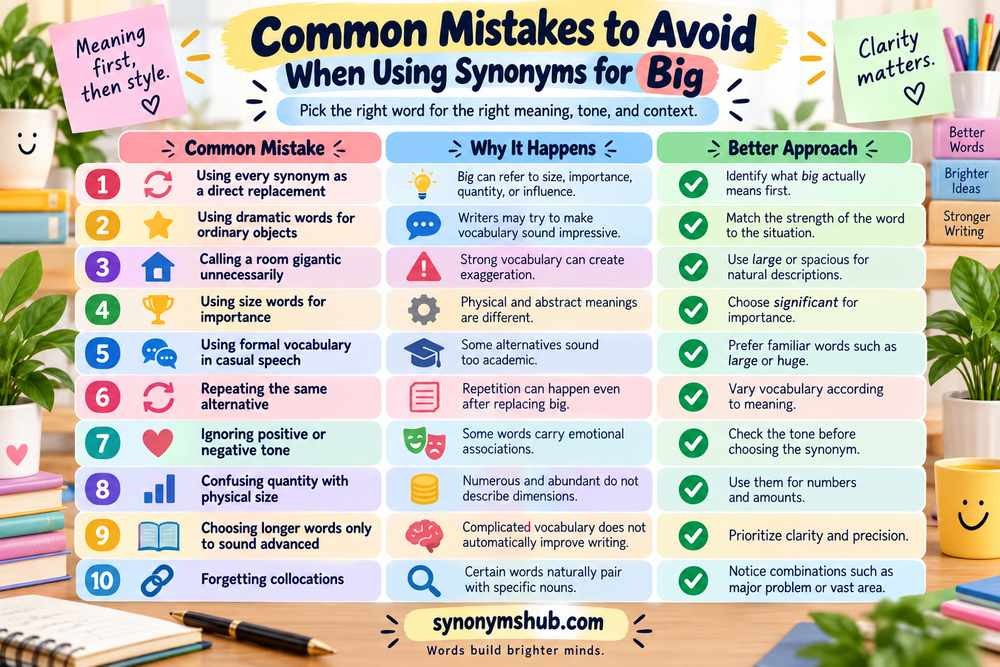
Building out your vocabulary is genuinely useful, but it’s easy to overcorrect. Every one of these words has its own weight and its own grammar attached to it. Something that sounds exactly right in one sentence can sound stiff or just wrong in another.
The fix isn’t finding the most dramatic synonym available; it’s finding the one whose meaning actually matches what you’re trying to say. So, consider this table data for next time.
| Common Mistake |
Why It Happens |
Better Approach |
| Using every synonym as a direct replacement |
Big can refer to size, importance, quantity, or influence |
Identify what big actually means first |
| Using dramatic words for ordinary objects |
Writers may try to make vocabulary sound impressive |
Match the strength of the word to the situation |
| Calling a room “gigantic” unnecessarily |
Strong vocabulary can create exaggeration |
Use large or spacious for natural descriptions |
| Using size words for importance |
Physical and abstract meanings are different |
Choose significant for importance |
| Using formal vocabulary in casual speech |
Some alternatives sound too academic |
Prefer familiar words such as large or huge |
| Repeating the same alternative |
Repetition can happen even after replacing big |
Vary vocabulary according to meaning |
| Ignoring positive or negative tone |
Some words carry emotional associations |
Check the tone before choosing the synonym |
| Confusing quantity with physical size |
Numerous and abundant do not describe dimensions |
Use them for numbers and amounts |
| Choosing longer words only to sound advanced |
Complicated vocabulary does not automatically improve writing |
Prioritize clarity and precision |
| Forgetting collocations |
Certain words naturally pair with specific nouns |
Notice common combinations such as major problem or vast area |
Conclusion
There’s nothing wrong with “big.” It’s simple, it’s clear, and for most everyday purposes it does exactly what you need. But lean on it for every description and your writing loses the ability to show real differences. It is between something large and something vast, between a problem and a crisis, between important and monumental.
That’s really what the Synonyms for Big list is for. A building can be massive. A stretch of land can be vast. Money put into something can be substantial. A win can be monumental. Someone with real sway can be described as prominent, and an experience that actually changes you can be called profound.
Frequently Asked Questions
What is the most common synonym for big?
Large is one of the most common and direct alternatives. It works naturally when describing physical size, quantity, or extent without adding a dramatic tone.
What is a stronger word than big?
Words such as huge, enormous, massive, gigantic, and colossal express much greater size. However, the best choice depends on how strong you want the description to sound.
What can I use instead of big in formal writing?
For formal writing, words such as substantial, significant, considerable, major, and extensive usually sound more precise. For instance, “a substantial increase” is often stronger than “a big increase.”
What word can replace big when describing importance?
Use major, significant, important, principal, or prominent, depending on the context. A “big decision,” for example, can often become a “significant decision.”
How do I choose the right alternative for big?
First, decide whether you mean physical size, quantity, importance, influence, or intensity. Next, consider the tone of your sentence. Finally, choose the word that communicates that specific meaning without unnecessary exaggeration.